
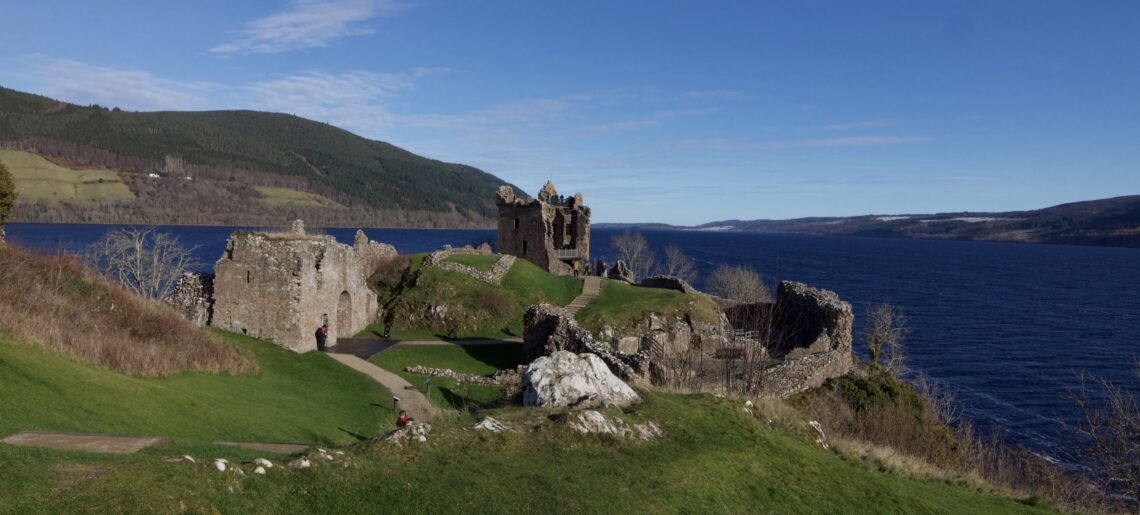
Urquhart Castle on Loch Ness
How can you avoid the crowds at a castle that’s usually swamped with visitors? One solution is to pick a day in winter, check the opening times, and arrive as early as possible. There are downsides to this strategy, however, as I found out when we visited Urquhart Castle in the middle of February. A sun that’s shining down out of a gloriously deep blue sky doesn’t guarantee that the wind blowing straight off the Cairngorms won’t freeze your extremities within a couple of minutes. Faced with this Arctic onslaught, your eyes will water so much that you’ll struggle to read the information boards, and with numbed fingers you’ll abandon your proper camera in favour of quick ‘point and shoot’ snaps with your phone.
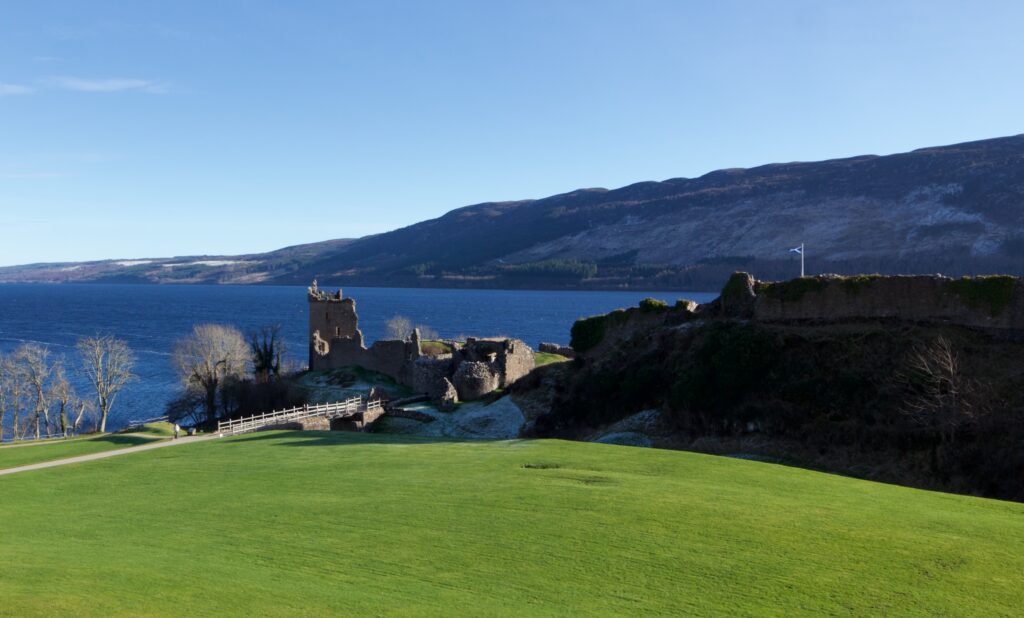
Sitting right on the edge of Loch Ness, Urquhart Castle has the natural advantages of being both easily accessible and hard to see from the busy A82 which passes right by its entrance. To get more than a glimpse, you need to drive down to the car park, pass through the ticket office and walk down a flight of stairs to the smartly designed Visitor Centre, where a glass frontage opens out onto the loch and the castle in all its splendour.
This wonderful view is dominated by the arresting installation of a trebuchet beside the public walkway, and we went over to take a closer look. Wielded in Scotland during the 13th and 14th centuries, a trebuchet wasn’t the kind of garden feature that a defending garrison ever wanted to see. The ultimate siege-breaker, it was capable of hurling massive stone missiles through castle walls, wreaking instant devastation. When he was besieging Stirling Castle, Edward I of England had an enormous one specially built, which he called the War Wolf.
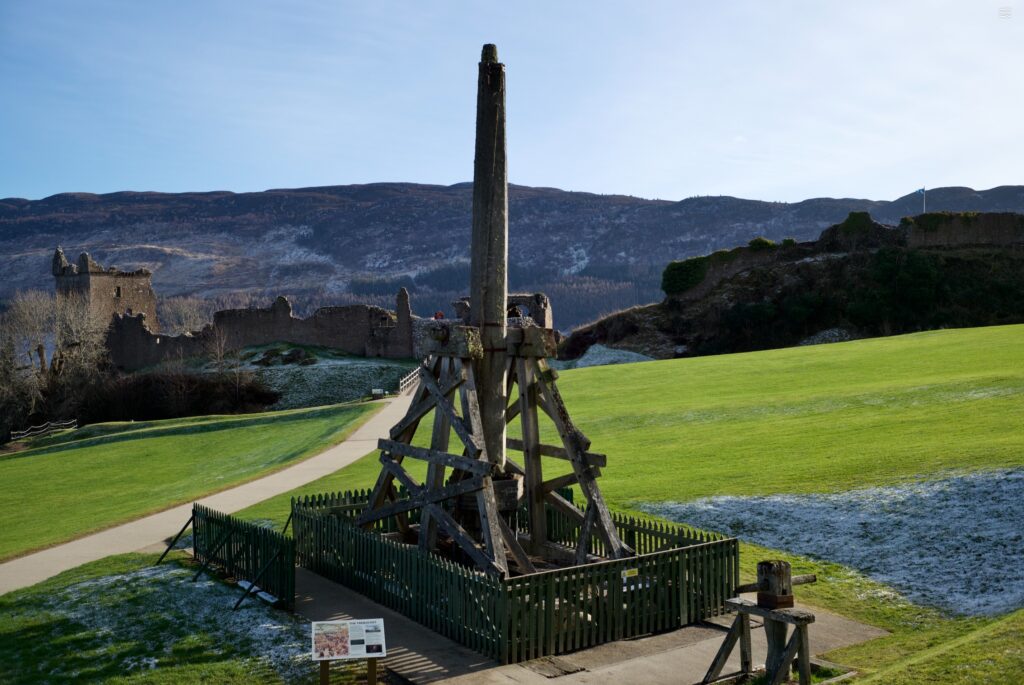
Although a number of stone balls were discovered at Urquhart Castle, there’s no written record of a trebuchet being used here. In 1998, two full-size trebuchets were built at the castle for filming purposes. This is one of them.
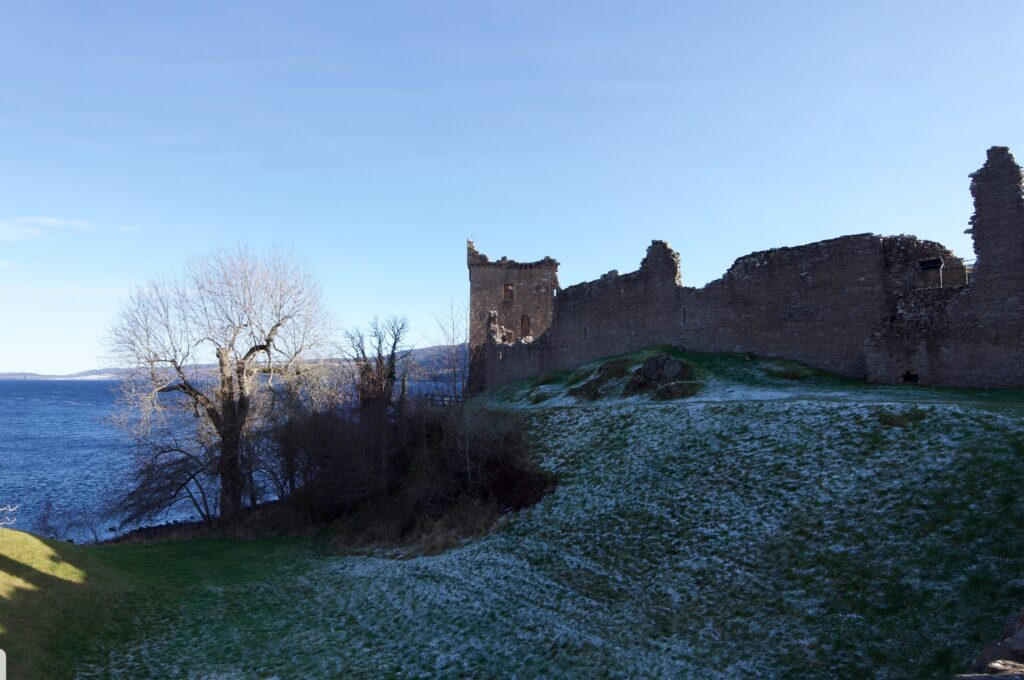
There was a scattering of snow still lying in places the sun hadn’t reached, and the wind was whipping the loch’s surface into restless little waves with white heads. We crossed over the rock-cut ditch, where a drawbridge was once raised to deter intruders, and entered the gatehouse. Here, if unwanted visitors had got over the ditch, they had to deal with an iron portcullis and then they faced another barricade while projectiles rained down on their heads.
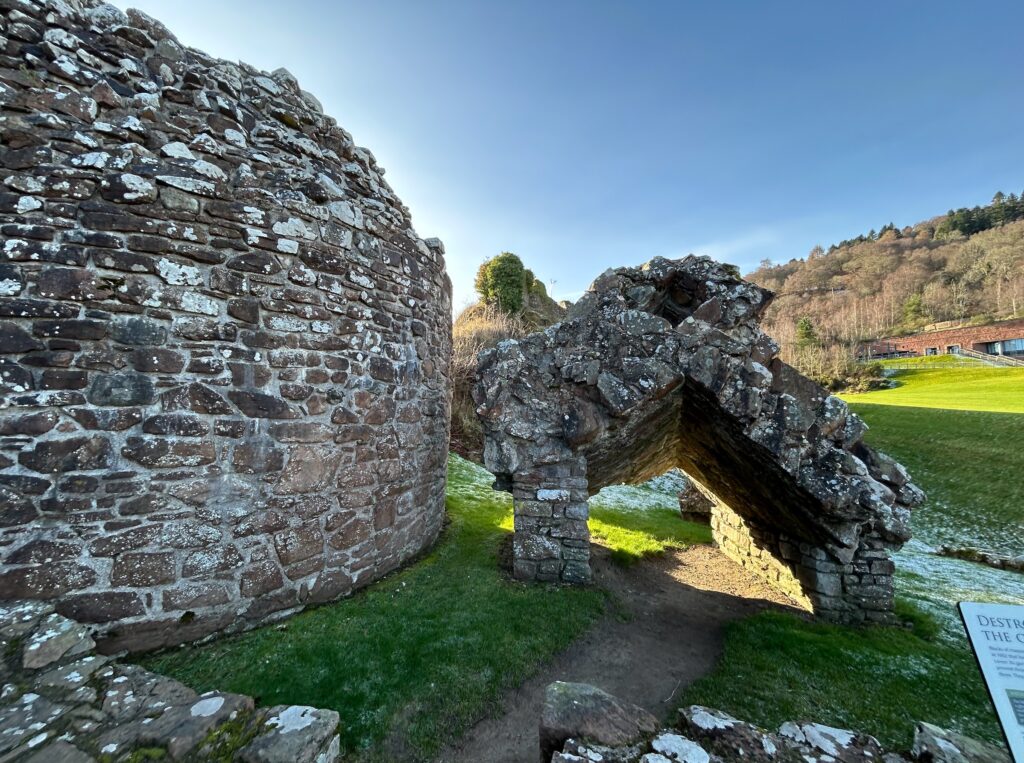
Above and below: The shattered gatehouse
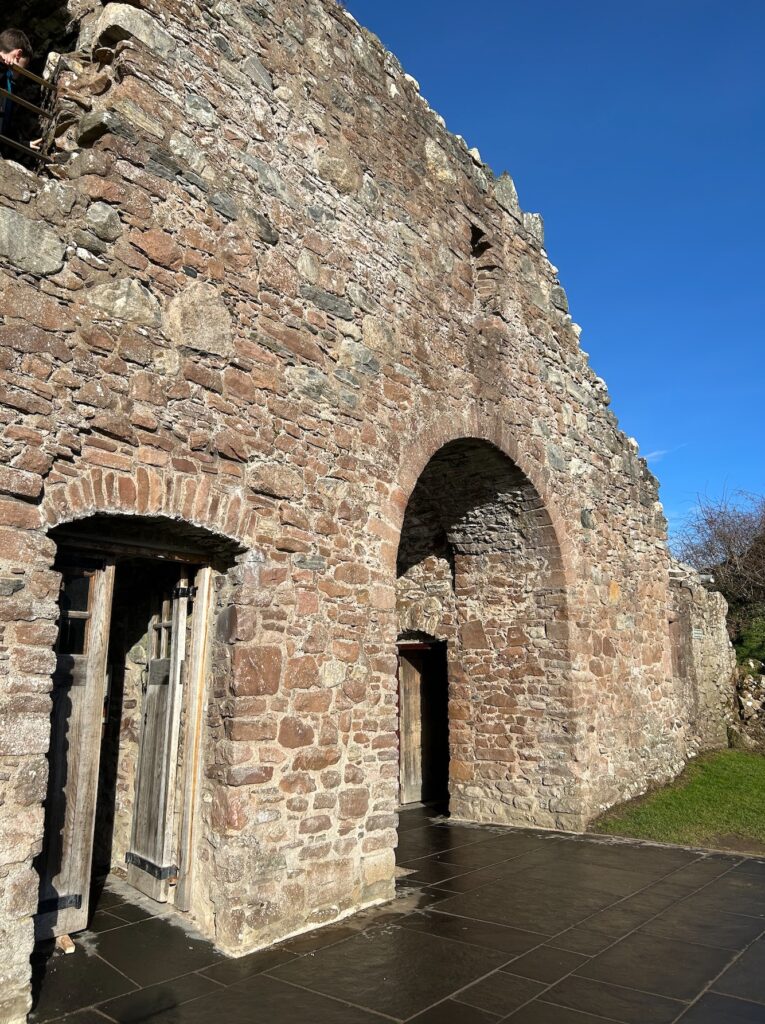
Once in the central courtyard, we decided to turn right and walk up some steps to a walled enclosure that sits on top of a natural rocky knoll.
The name ‘Urquhart’ is said by some sources to be a version of Airdchartdan, itself a mixture of Old Welsh and Gaelic words meaning either ‘by a rowan wood’, or ‘promontory by a thicket’, or ‘fort on a hill’. If there was indeed a ‘fort on a hill’, it was likely situated on this rocky knoll, where vitrified material has been found. Vitrified rock, in other words rock that has been heated so much that it has turned to a kind of glass, occurs quite widely in hill forts throughout Scotland and continues to puzzle historians as to exactly how it was created, and why.
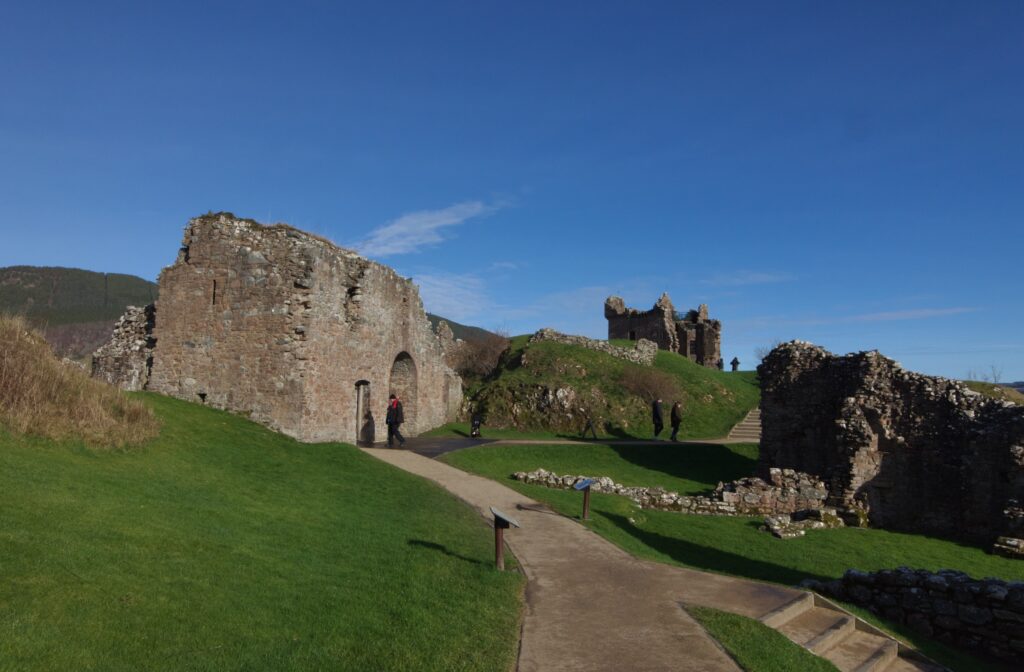
View back to the gatehouse
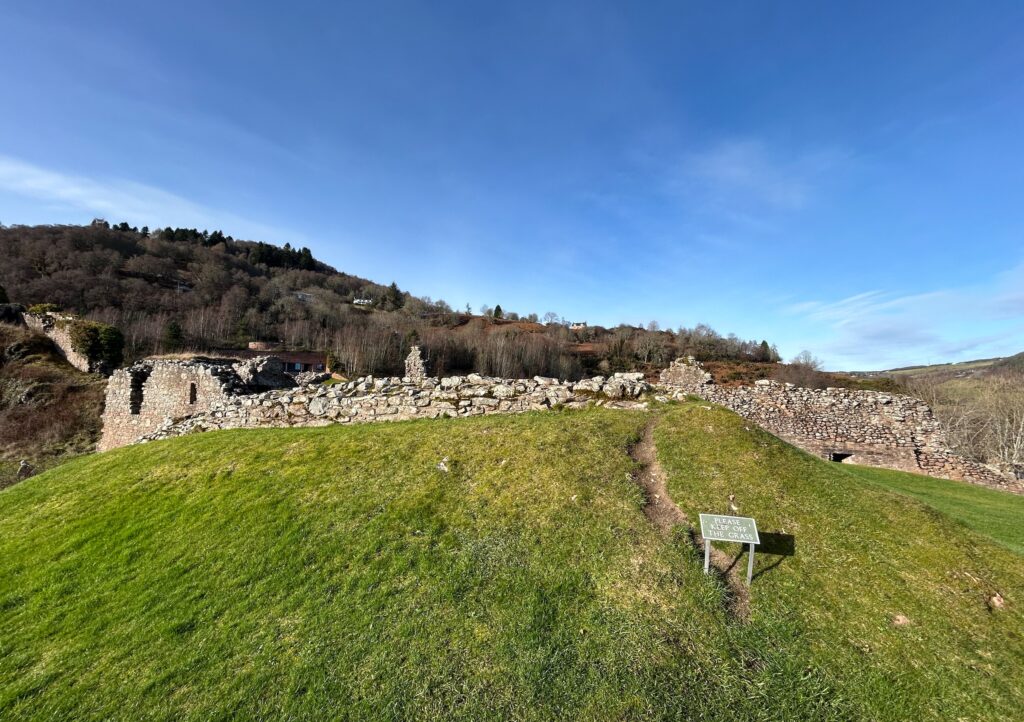
The likely site of a Pictish fort, later overlaid by medieval stonework. ‘Please keep off the grass’ says the sign. Were the Picts this polite?
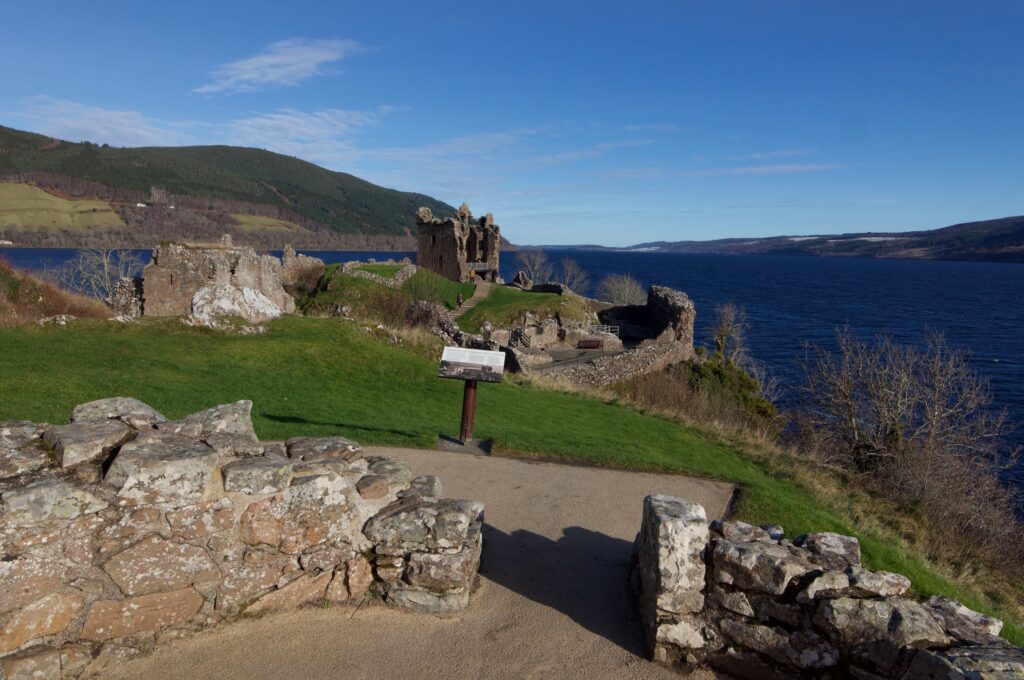
Above and below: Commanding views up and down the loch. In a time when travel by water was easier than travel overland, this would have been a huge advantage
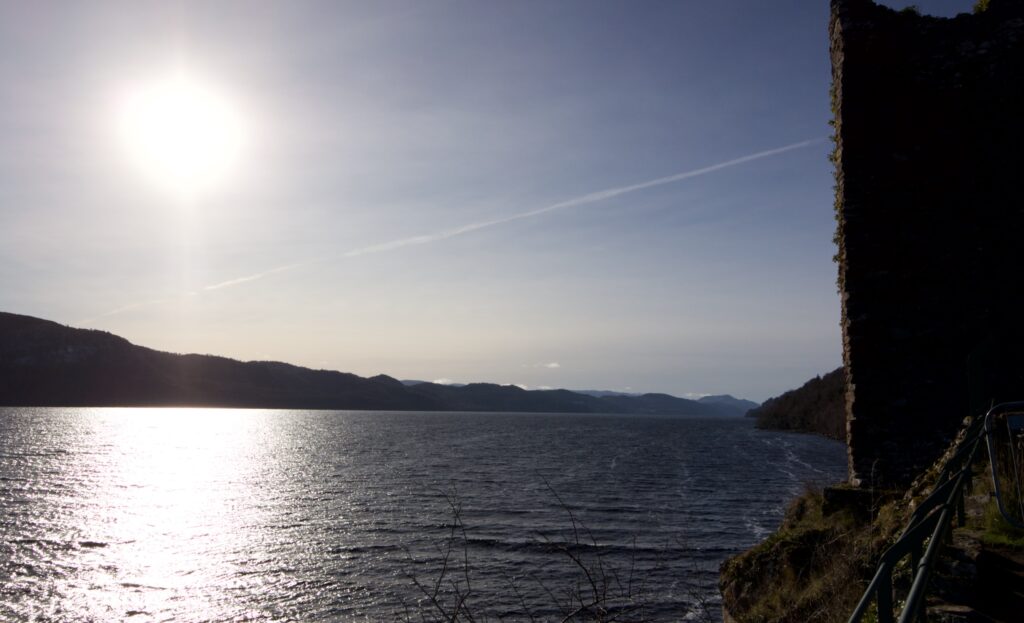
Around 580 AD, St Columba is said to have his made his way up Loch Ness in order to visit the Pictish King Bridei, whom he persuaded to convert to Christianity. It’s said that on his journey up the loch, Columba visited an elderly Pictish nobleman named Emchath, who lived at Airdchartdan. Emchath was close to death, and Columba baptised him and his household.
‘Emchath’s residence may have stood on the site of the castle. The discovery of a fragment of a Pictish brooch from the late 700s or early 800s hints that the promontory was possibly a high status Pictish site.’
Historic Environment Scotland
An early encounter with Nessie…
I was interested to read that St Columba (or more precisely his biographer, St Adamnan) recorded a sighting of an ‘aquatic monster’ in the River Ness, which flows out of Loch Ness. Adamnan relates how St Columba was preparing to cross the River Ness with some companions when he noticed a group of people burying the body of a man on the bank.* They told him that their friend had been attacked and killed by a monster while he was swimming in the river.
Undeterred by this news, Columba calmly asked one of his companions to swim over and fetch the fishing boat that was moored on the far side. A man named Lugne Mocumin jumped fearlessly into the water and started swimming. The monster surfaced and pursued him, but Columba merely raised his hand and made the sign of the cross in the air, saying: ‘Thou shalt go no further, nor touch the man; go back with all speed.’ At these words, the monster fled ‘more quickly than if it had been pulled back with ropes.’ Lugne presently returned with the boat, and St Columba and his party crossed the river in safety.
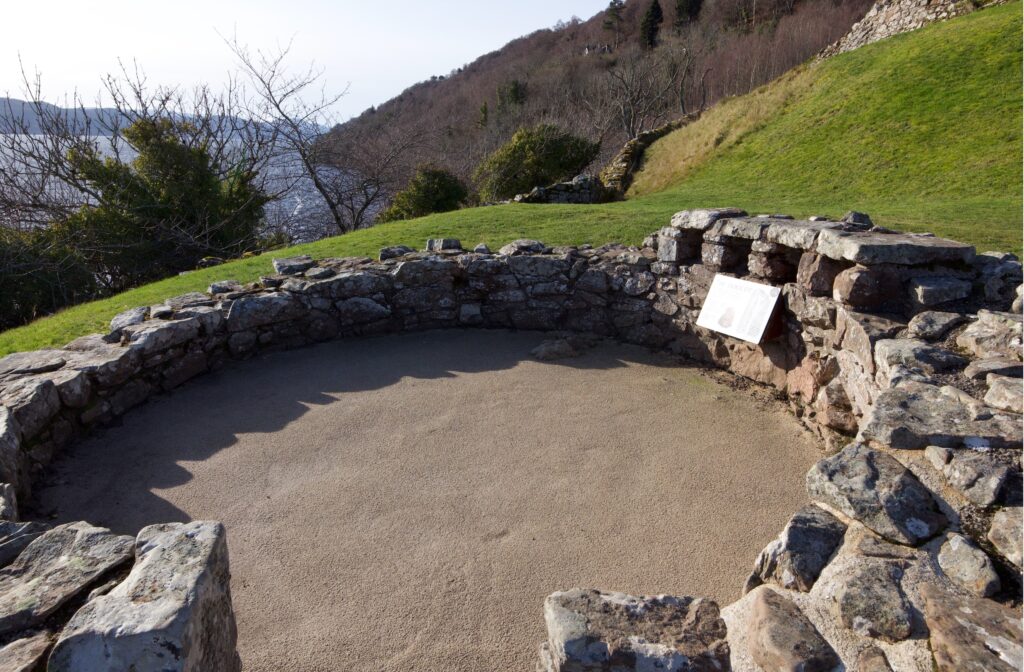
The remains of a doocot (dovecote)
Some sources have suggested that William the Lion, King of Alba from 1165 to 1214, had a castle at Urquhart. There is better evidence that an early castle was built here in the 13th century by Alan Durward, a powerful figure who had married Marjorie, the daughter of King Alexander II. In 1275, after Alan’s death, Urquhart Castle was granted to John II Comyn of Badenoch, ‘the Black Comyn’, a nobleman whose other castles included Inverlochy near Fort William. This was was a turbulent period in Scottish history: the ill-fated King Alexander III died in 1286 after a night-time fall from his horse, leaving as his only legitimate heir a three-year-old girl – his granddaughter, Margaret, whose mother had married King Eric II of Norway.
As the new Queen of Scotland, this little girl, known as ‘the Maid of Norway’, was now a desirable addition to a royal family tree. Between them, King Eric II of Norway, King Edward I of England, and six Guardians of Scotland (appointed to rule during Margaret’s minority) agreed that she should marry the English king’s three-year-old son. In 1290 Margaret, then aged seven, was sent by ship to Orkney, which was then part of Norway. From there, it was intended that she would travel south to Scone for her inauguration. But the poor child took ill on the voyage and died in Orkney, possibly of seasickness or food poisoning.
After that, there were at least a dozen contenders for the crown of Scotland, and while Edward I of England was trying to arbitrate between them he insisted that he should be recognised as Lord Paramount of Scotland. The short story is that no agreement was reached, and it all descended into the Wars of Independence. So, in 1296, Edward was rampaging around Scotland, and among the strongholds he captured – either with or without a trebuchet – was Urquhart Castle.
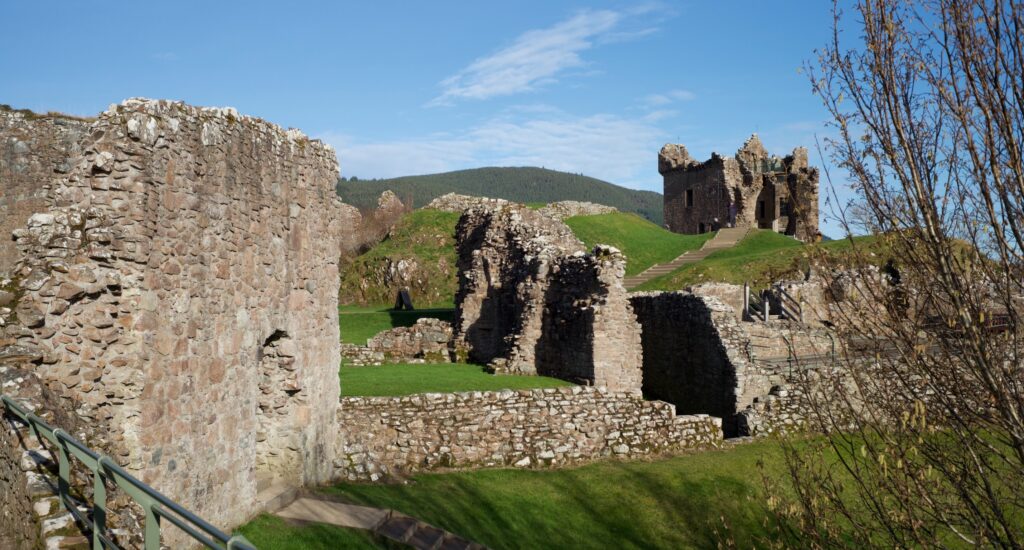
Over the next 50 or 60 years, the castle changed hands between England and Scotland several times. There was no peace even after the Wars of Independence had settled down, because by that time the Macdonalds, Lords of the Isles, had risen to power in the west of Scotland, and they made frequent and devastating raids up the Great Glen, often seizing the castle until it was recaptured by the crown.
When the castle passed to Clan Grant in the early 1500s, the new owners proceeded to build an impressive tower house now known as the Grant Tower. However, the Macdonalds continued their raiding, on one occasion driving away 300 cattle and 1,000 sheep; on another, they helped themselves to ‘an enormous hoard, including three great boats and 20 guns.’
In his book Olden Times in a Highland Parish, published in 1914, historian William Mackay tells the story of one of these raiders, a man by the name of Domhnull Donn Mac Fhir Bohuntuinn. Domhmull (or Donald) was a gifted bard, and when he met Mary Grant, a young woman who lived in Urquhart Castle, they both fell in love. However, with the Macdonalds’ track record, this story was never going to end well. Mary’s father forbade the match, and the lovers resorted to secret meetings in the woods that flank Loch Ness.
On one of the Macdonald raids, during which Donald Donn and his companions had ventured as far as Ross-shire and were driving home a fine herd of cattle, they paused at a farm called Borlum that lay in the Great Glen, quite close to Urquhart. But Mary’s father discovered their whereabouts, and declared: ‘Bheir an Diabhal mise a mo bhrogan mar teid Domhnull Donn a chrochadh!’ (‘The Devil may take me out of my shoes, if Donald Donn is not hanged!’) With Grant’s men and their hounds hot on his trail, Donald took refuge in a remote cave on the hillside. Here, in the company of some herdsmen from Glenmoriston, he whiled away the time composing songs in praise of his love.
Inevitably, fate caught up with Donald, in the form of a message that was delivered to him at the cave. Ostensibly from Mary herself, it invited him to the house of a friend, where he and Mary could meet in safety. Donald’s heart overruled his head, and he walked straight into a trap. Swiftly convicted of cattle-stealing, he was condemned and beheaded (which he chose in preference to hanging). While Donald was still imprisoned, Mary composed a defiant love song:
Gur e m’ athair rinn an dò-bheart
Mise chumail gun do phòsaidhMy father did an evil thing
Keeping me from marrying you
from Tha Mo Rùn air a’ Ghille (‘I Love the Lad’)
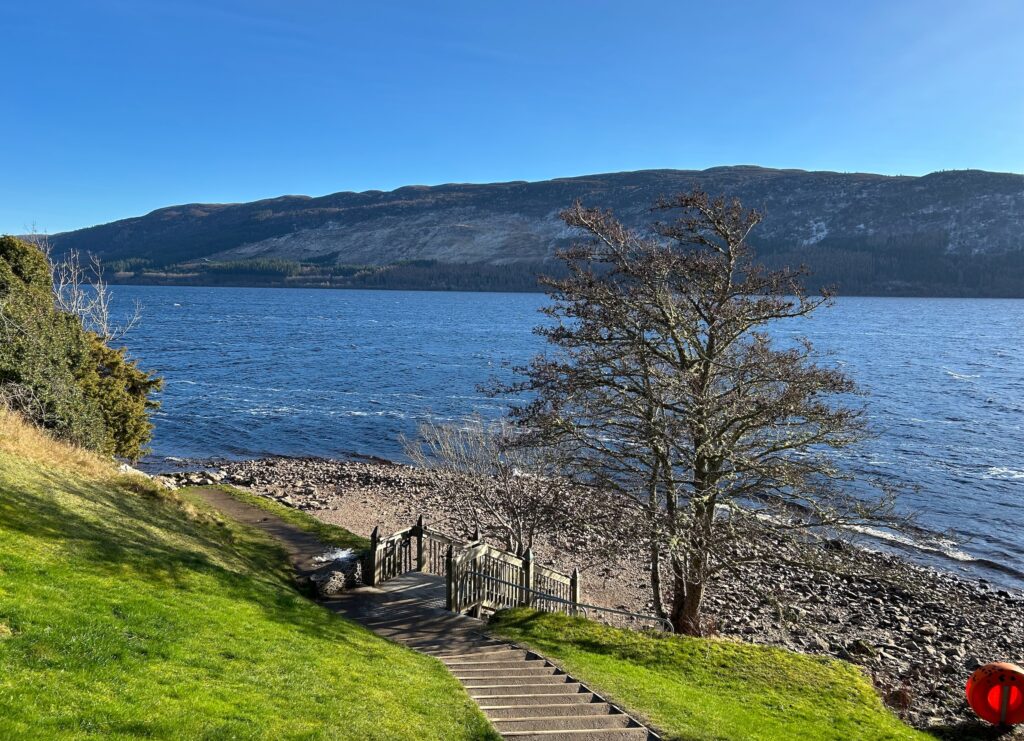
View from the Water Gate. Most of the castle’s supplies arrived here by boat
In the Glorious Revolution of 1688, the deposed King James II (and VII of Scotland), who had converted to Roman Catholicism, was replaced by a Protestant King and Queen: William III (William of Orange) and his wife Mary, who was King James’ daughter. This event sparked a series of Jacobite uprisings, supported by those in favour of restoring James or his Catholic descendants to the throne. For two years, Urquhart Castle was used as a garrison for government forces attempting to subdue the rebellion. When the soldiers left in 1692, they blew up the gatehouse so that the castle was not worth occupying by Jacobite rebels.
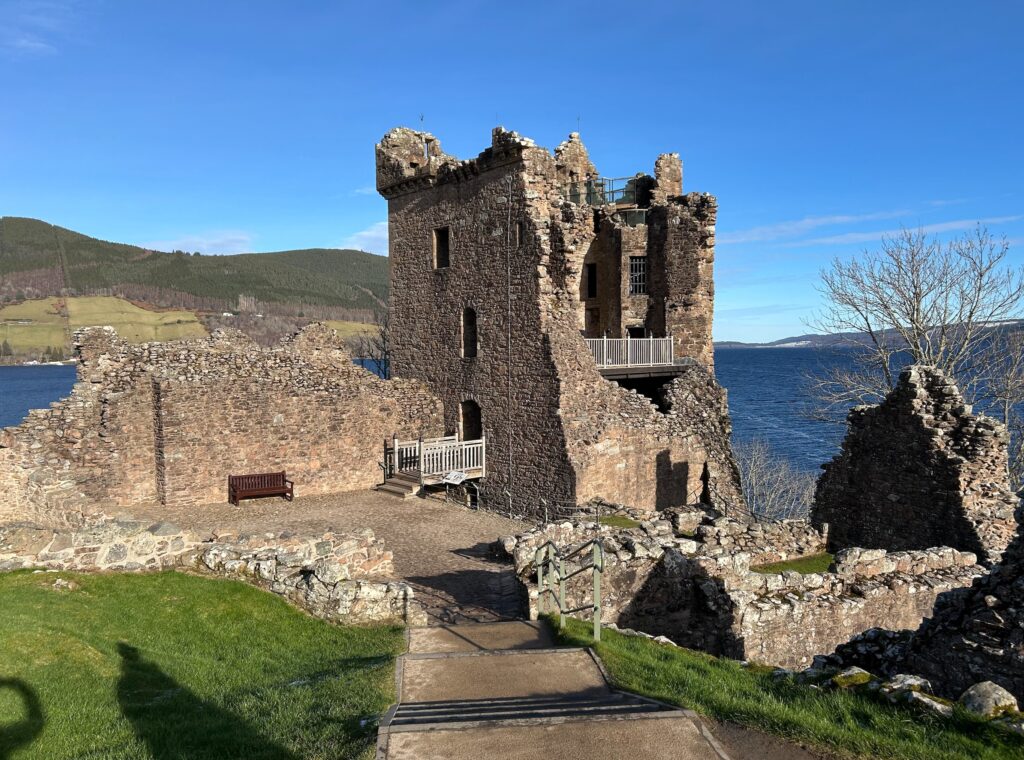
The south wall of the Grant Tower collapsed during a storm in 1715. (It is pure coincidence that 1715 is the date of another Jacobite uprising)
In the centuries that followed, the remains of Urquhart Castle were plundered for building materials. As William Mackay put it in 1912, ‘gunpowder and decay had done their work; and henceforth the Royal Castle, the pride of the North since the days of the War of Independence, is but a crumbling ruin.’
Urquhart Castle passed into state care in 1912, and over the following decade the ruins were consolidated. Any remaining rubble was cleared away. According to an information sign, ‘while well-intentioned, this work removed important clues to Urquhart’s past and the shape and purpose of its many buildings.’
A tradition claims that there are two secret chambers under the ruins of the castle. One is filled with gold, and the other contains a plague. Because of the obvious risk of opening the wrong chamber, no one has ever felt bold enough to go looking for the treasure.
Colin and I climbed up the Grant Tower to the topmost surviving storey – now roofless – from which there are stunning views over the castle and the loch beyond. Did Mary Grant sit up here and wait in vain for Donald Donn?
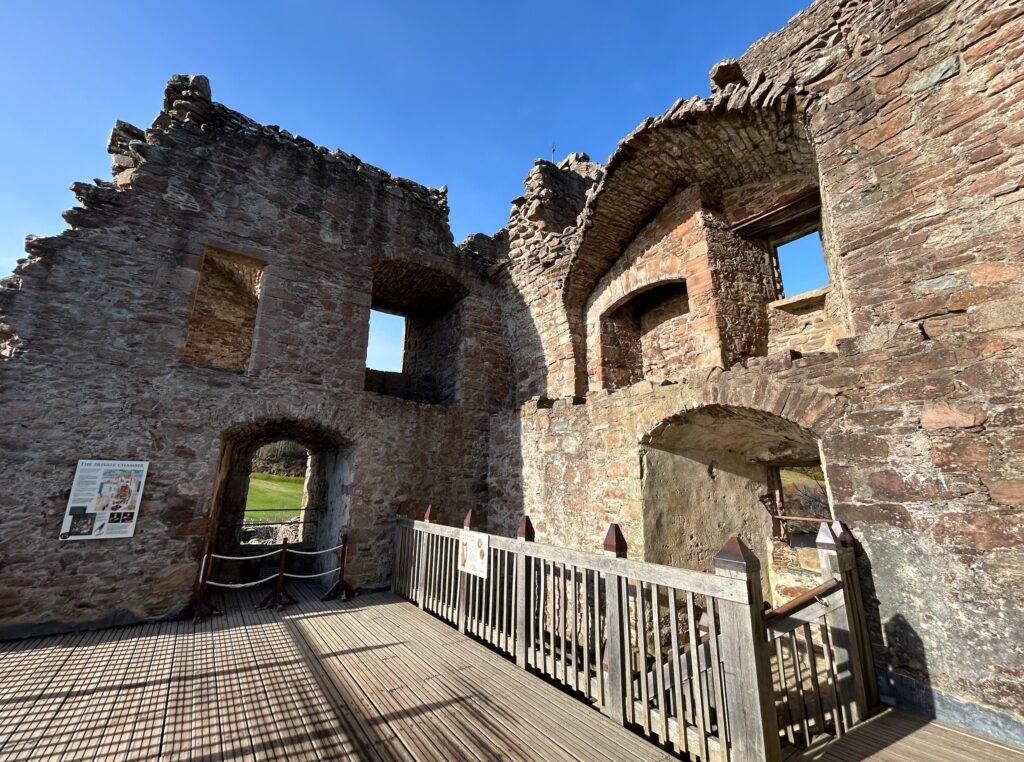
Above: the first and second storeys of the Grant Tower, in which the Laird had private chambers (the floor between them has gone); and (below) the top storey
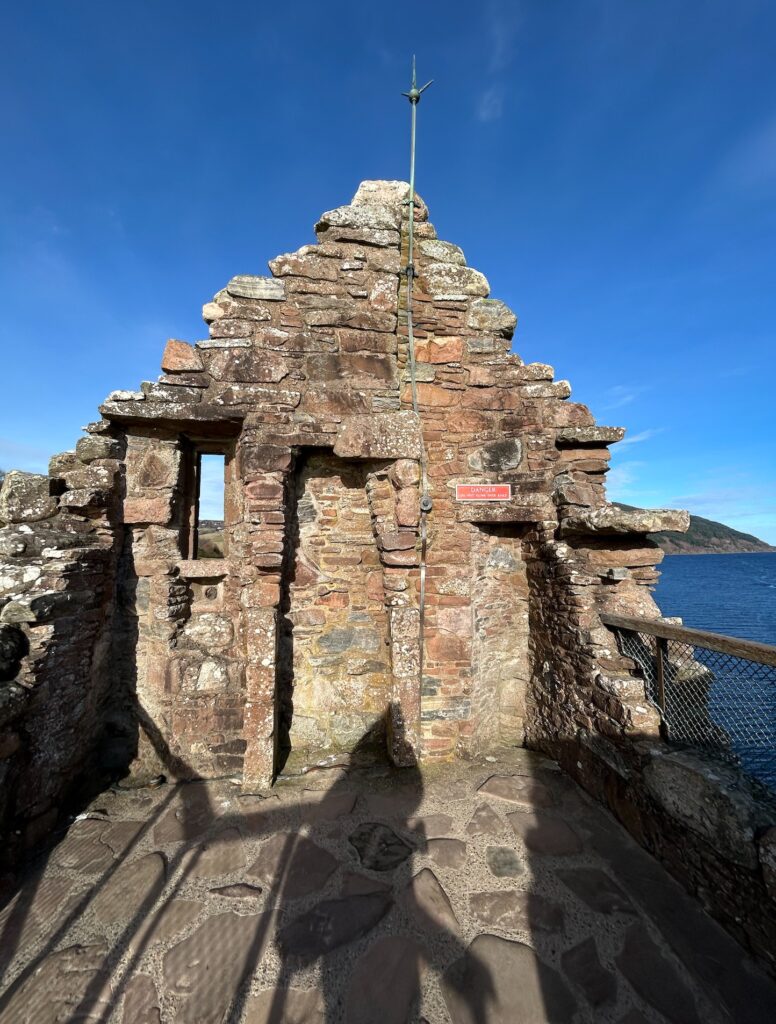
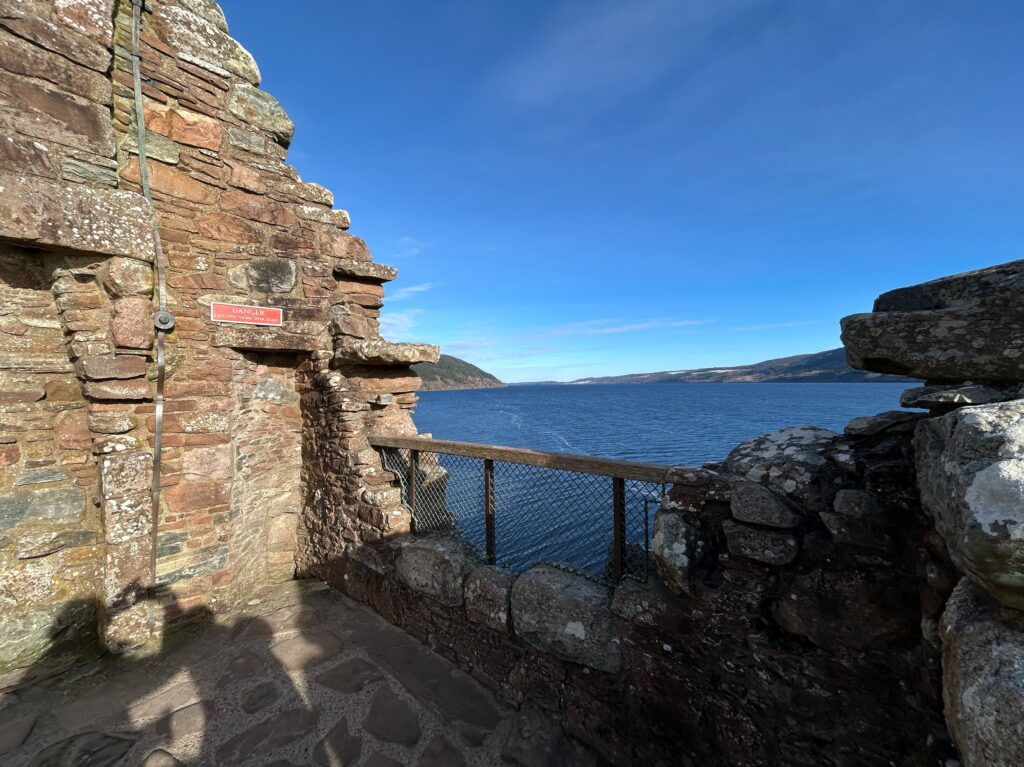
A warning sign said: ‘Danger – do not climb over the rails’ . Considering that there’s a vertical drop the other side, it’s alarming to think that anyone is tempted
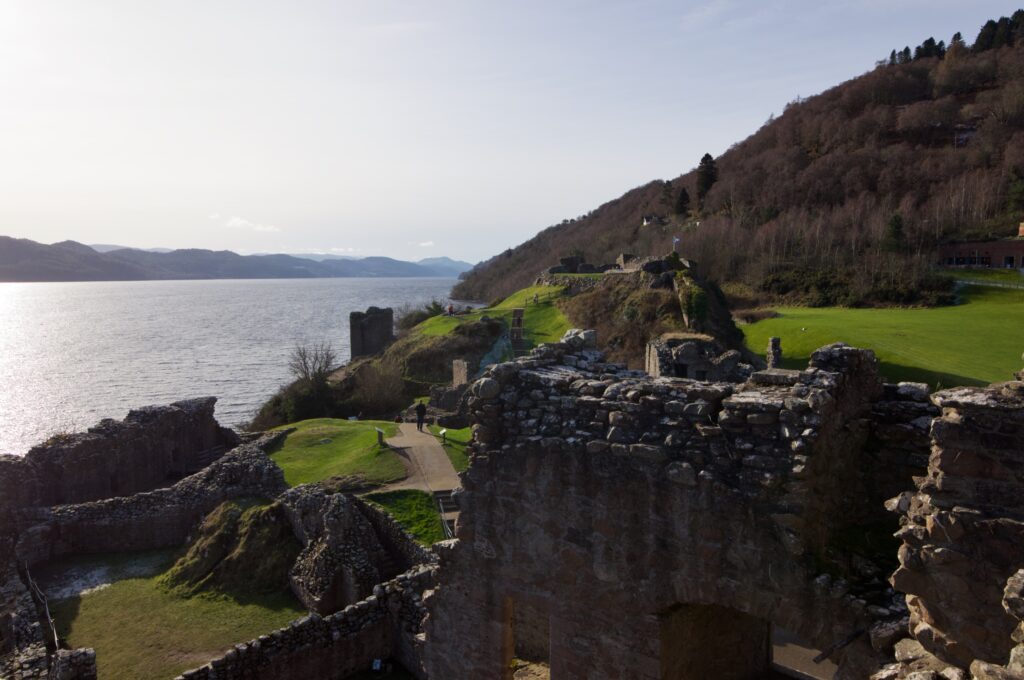
View from the Grant Tower
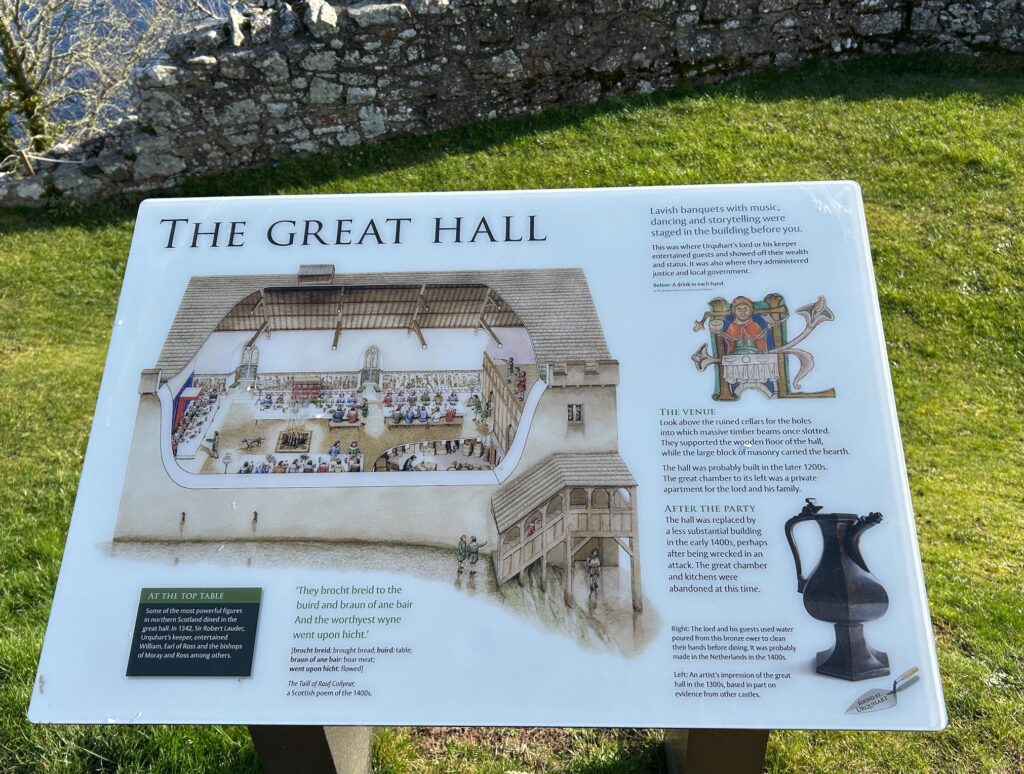
With so much conflict in its history, it’s hard to imagine Urquhart Castle as a comfortable family home. However, information signs depict the rooms in their heyday as being warm and well furnished: there are busy kitchens and well-provisioned cellars, bustling servants and feasting in the Great Hall. There were also illustrations of archaeological finds unearthed here, some of which are displayed in a museum in the Visitor Centre.
I’ve always been curious about the meaning of ‘Ness’ as it occurs in Loch Ness and the River Ness. The old Norse word of ‘nes’ refers to a promontory or headland, but this doesn’t seem to fit easily here. There are, however, two wonderful legends that offer alternative explanations, preserved by William Mackay (1848-1928), the historian I’ve already quoted, who was a native of Glen Urquhart and a founding member of the Gaelic Society of Inverness.
The first goes back to the time before there was any loch there at all. A spring flowed down into the glen from high on a hillside, and because its waters had been blessed by a druid they were believed to heal any ailment. But the druid had warned that, after drawing water from the spring, it should always be covered by a stone; failure to do so would result in desolation overtaking the land. One day a woman was drawing water when she heard a cry from her baby, alone in the house far below. Concerned that the child had got too close to the fire, she rushed back down and in her haste she forgot to replace the stone over the spring.
Quickly, the water levels rose and flooded the glen, so that people had to abandon their homes and escape to the mountains. In their alarm, they called out: ‘Tha loch ‘nis ann, tha loch ‘nis ann!’ (‘There is a loch now, there is a loch now!’) According to Mackay, ‘it is called Loch-Nis to this day.’ (There’s a resemblance here to the tale of how the Cailleach left the spring on Ben Cruachan untended, thereby creating Loch Awe.)
The second version is even more appealing, because it takes us unexpectedly back to one of my favourite stories. You might remember an earlier blog post, based around a tale that is woven into the stones of Beregonium or Dun Mac Uisneachan, a hill fort in Argyll. Two lovers named Deirdre and Naoise, on the run from a jealous king, took refuge in Glen Etive and lived the joyful but transient lives of fugitives before being lured back to their homeland and their ultimate doom.
According to William Mackay, ‘the name of Naois is borne by Loch Ness, the river Ness, and Inverness,’ and he adds that the Iron Age hill fort of Dun Dearduil (or Dùn Deardail), which lies in the Great Glen near Fort William, preserves the name of Darthula, one of the alternative names for Deirdre. Naoise seems to have roamed much further afield than Glen Etive, venturing north up the Great Glen. A clue is given in Deirdre’s lament on leaving Alba, in which she recalls some of the gifts she received from Naoise:
‘He sent to her a frisking herd—
A wild hind and a fawn at its foot;
And he went to her on a visit
As he returned from the host of Inverness.’
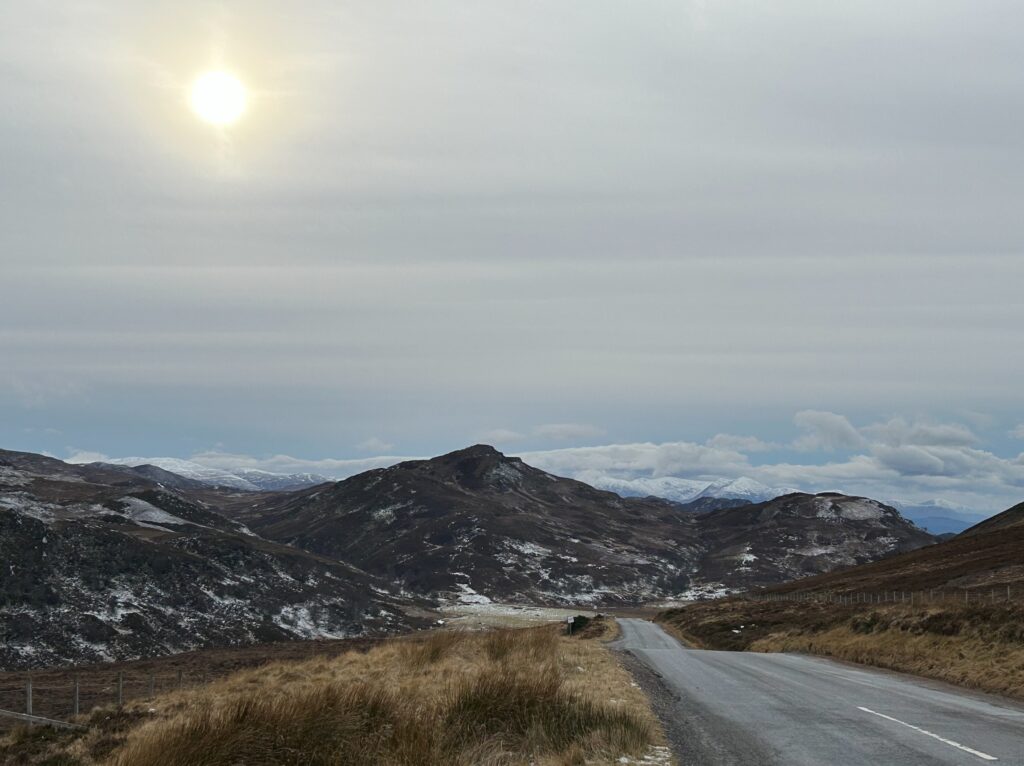
No wild hinds or fawns on our own travels through the glen, although we did see a group of stags that were browsing together on a hill above Fort Augustus. Heading south again, we could see a wall of grey cloud behind the white peaks of the Nevis range, and the sun was swallowed up into an early dusk.
Despite my frozen fingers, I think it was a good idea to visit Urquhart Castle during the winter months because I know how busy it gets in the summer. I really did struggle to use a camera – Colin fared better than me – but the upsides were the clarity of the light and the low visitor numbers. And as a result, I’ve learned a great deal about its history, with the added delight of coming across one or two surprising stories.
–
Footnote
* The Latin text describing St Columba’s crossing of the River Ness reads: ‘…accessiset ripam alios ex acollis aspicit misellum humantes homunculum.’ (‘…he approached the bank and saw others from the hills burying the poor little man.’) The word homunculum leapt out at me because of a brilliant new TV series by Mackenzie Crook, called ‘Small Prophets.’ Until recently I had no idea what homunculi were. I didn’t expect to find one in the Life of St Columba, although in this case it can mean nothing more than a small-sized man.
–
Reference and quotes
- Historic Environment Scotland: Urquhart Castle
- Historic Environment Scotland: the War Wolf at Stirling Castle (blog post, James MacIvor, 2024)
- William Mackay, Urquhart and Glenmorison: Olden Times in a Highland Parish (1912)
- The Life of St Columba, ed. William Reeves (1874)


9 Comments
Peter
Very wonderful article with great accompanying photos. Thank you for taking the time to write and post your accounts of the history and folklore of vthe arious places you have traveled, they are fantastic!!!
Jo Woolf
Thank you very much, Peter! You are very welcome and I’m so glad to hear you enjoyed it. It’s a pleasure to share our visits to these places.
freespiral2016
What’s rich and ancient history – I loved reading about St Columba’s encounter with Nessie, and the many origin stories of the word Ness.
Jo Woolf
Thank you! I’m glad you enjoyed it. It’s fascinating to see just how long the Nessie legend has existed.
Richard Miles
Dear Jo,What a fascinating blog.A complicated history interwoven with romance and tragedy and incredible photos,you were lucky with the weather,perfect.I have been past the castle several times and not sure why I didn’t have a look.As a digression,a close friend of mine helped to bring a boat back from Norway in 1988,across the North Sea,through Loch Ness and the Caledonian canal,down to Bristol docks for re-furbishment.Her name was Silvery Light built in 1884 in St Ives.This is only a tenuous connection,more info can be obtained on the net if interested.
The weather here in Dartmoor is finally more settled after nearly two months of rain.
With kindest regards.
Richard
Jo Woolf
Thank you so much, Richard! It’s almost overwhelming how much history there is here – hard to assimilate all the sieges, raids and rebellions, and the changes of ownership. There can’t have been many periods when its inhabitants could sleep easy in their beds. That must have been a wonderful journey for the ‘Silvery Light’, all the way from Norway and down the Great Glen. What an experience. I did look her up and think this might be her: https://www.nationalhistoricships.org.uk/register/1838/silvery-light A lovely looking boat! I’m glad that you’re getting more settled weather now. Our wind has finally turned to the west, so it’s milder but squally. Some spring sunshine would be nice, for everyone! Very best wishes, Jo
Bob Hay.
Hi Jo once again a terrific and interesting article for all us expats. While you were freezing🥶 we were being broiled – slowly, in 40C temperatures.🥵
I never realised Urquhart was so big until looking at Andrew Spratt’s reconstruction of it based on existing ruins and historical records.
Your faithful followers might find this reconstruction of interest like all Andrew’s works on castles and battles.
http://www.maybole.org/history/castles/Urquhart%20%20castle.jpg
Jo Woolf
Thank you very much, Bob. I couldn’t cope with that heat! I’ll keep my freezing fingers, thank you. Andrew Spratt’s illustration is really good, and gives a great sense of scale. Thanks also for the link to the latest Nessie research which I look forward to watching. I’ve got a copy of ‘A Monstrous Commotion’ by Gareth Williams (2015) which I can also recommend. When you realise how many sightings there were, often within a short space of time, but of apparently completely different creatures, you start imagining a kind of shape-shifting prankster!
Bob Hay.
Sorry Jo, forgot to include this link to explaining Nessie, not of course wanting to destroy a lucrative tourist icon in the process. What is it they say, ‘Though the heavens may fall the truth must prevai’.l