
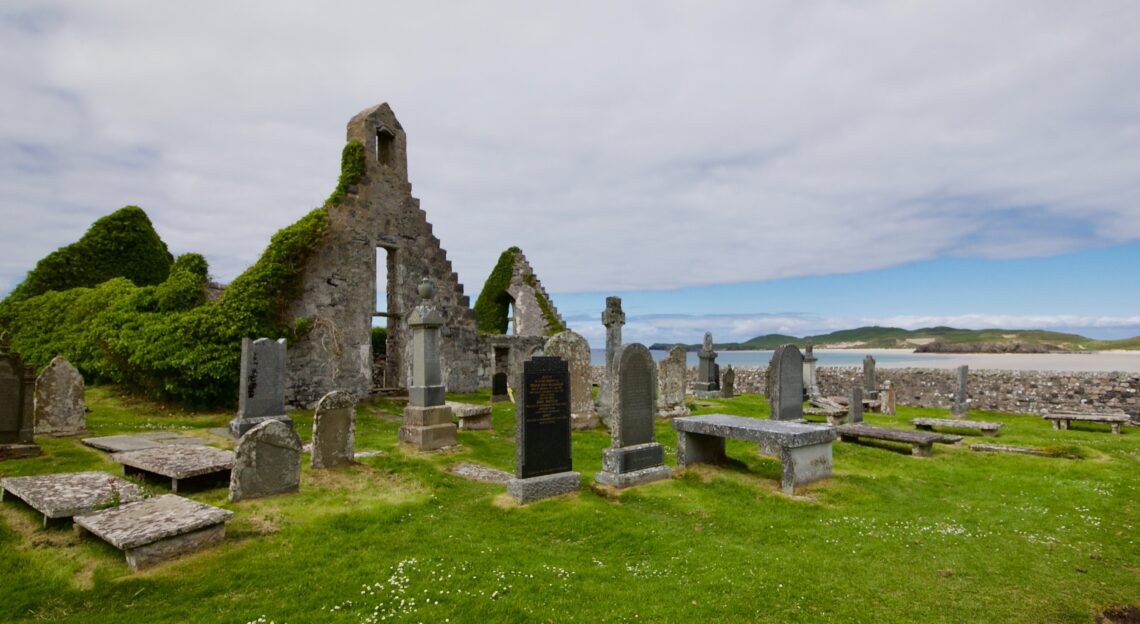
Balnakeil Chapel in Sutherland
When you’re standing on the shore at Durness and facing north, there’s really nothing in the way of land between you and the Arctic. Long lines of cloud skim the horizon, in a way that makes you think about the curvature of the Earth. In the near distance, the sea has taken bites out of a peninsula that stretches for two miles in a north-westerly direction, its wide sweeping bays flanked by sand dunes and marram grass. You can walk right to the end, passing between dunes that rise to nearly 200 feet, eventually climbing still further onto a machair-topped headland that is speckled with orchids and gentians from early summer.
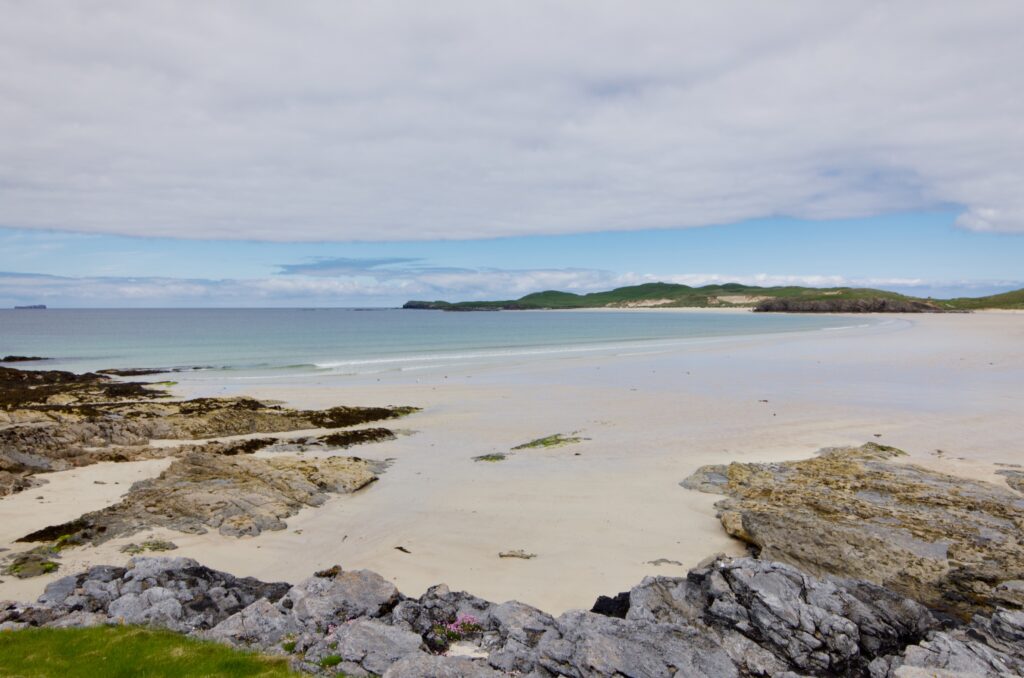
At the landward end of the peninsula is a place called Balnakeil, a name which likely derives from the Gaelic Baile na cille, the settlement of the church. Here, a ruined chapel overlooks the shore, its graveyard protected from the sea by a natural bank and a sturdy stone wall. Safe from storm waves, perhaps, but close enough to feel their spray.
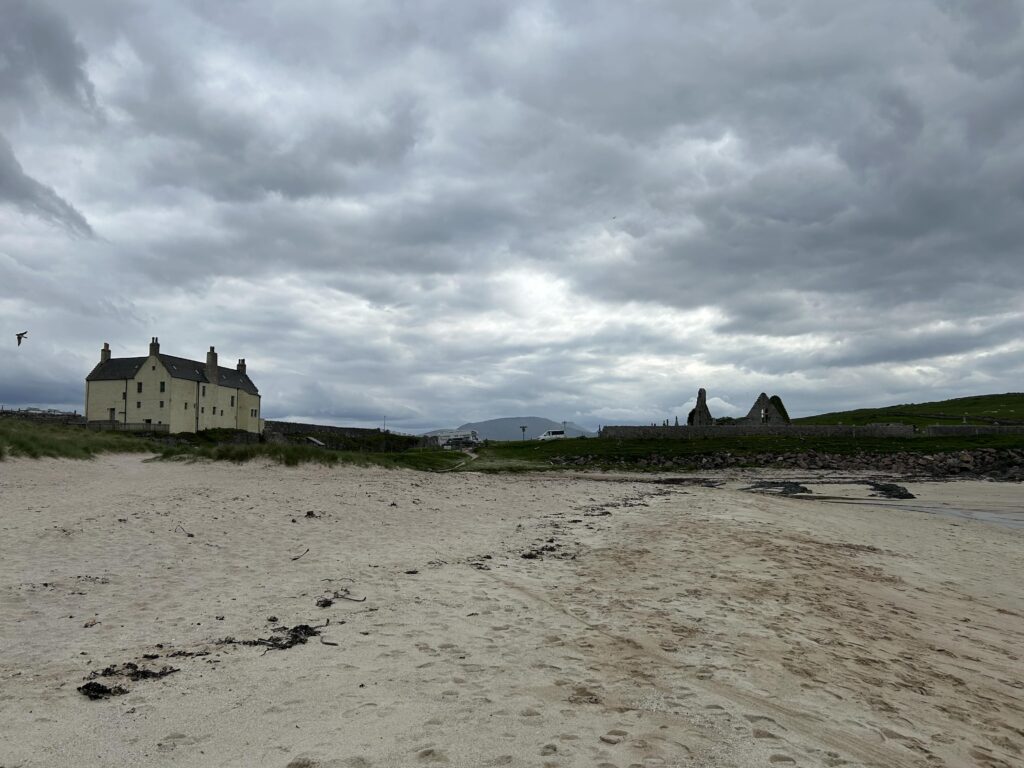
Balnakeil House (left), and the chapel on the right. The house dates from the 1700s and stands on the site of an earlier summer residence of the Bishops of Caithness
According to tradition, a monastic site was founded here by St Maelrubha in about 720 AD. St Maelrubha was one of the missionary-saints who sailed from Ireland in the wake of St Columba and St Brendan, in order to convert the Picts to Christianity. Like St Columba, Maelrubha was descended from the Uí Néills, High Kings of Ireland whose ancestor was reputed to be a fifth-century king named Niall of the Nine Hostages.
Born around 642 AD in what is now Northern Ireland, St Maelrubha travelled widely, from Islay through mainland Argyll and northwards to Skye and Sutherland, and his journeys can be traced by the string of chapels that bear his name; there is one close to our home in Craignish. He founded a monastery at Applecross, a remote community in the northwest, which is still remembered in its Gaelic name A’ Chomraich or sanctuary. The land around it was regarded by law as holy ground, and fugitives could claim sanctuary if they came within six miles of the church.
At some stage, St Maelrubha became known as The Red Priest. It has been suggested that this originated in an attempted translation of ‘rubai’ in Máel-rubai, an early form of his name. An entry in the Highland Historic Environment Record says: ’An old font known as the “Clach na sagart ruadh” or “stone of the red priest”… lay in front of the door of Balnakeil House before 1867 but by 1874 it had been moved to within the church.’ A later survey, made in 1980, notes that the font ‘has been removed by persons unknown in recent years.’ It’s interesting to note that there is a Red Priest’s Stone (Clach an t’Sagair Ruaidh) at Skail in Strathnaver, a remote settlement at least 30 miles to the south-east of Durness. This one is incised with a cross and is said to mark St Maelrubha’s grave.
Although St Maelrubha is generally thought to have died in 722 AD, which would have been his 80th year, there are conflicting accounts of how and where it happened. One story claims that he died in Strathnaver, at the hands of raiding Norsemen or Danes; another states that he passed away peacefully in Applecross.
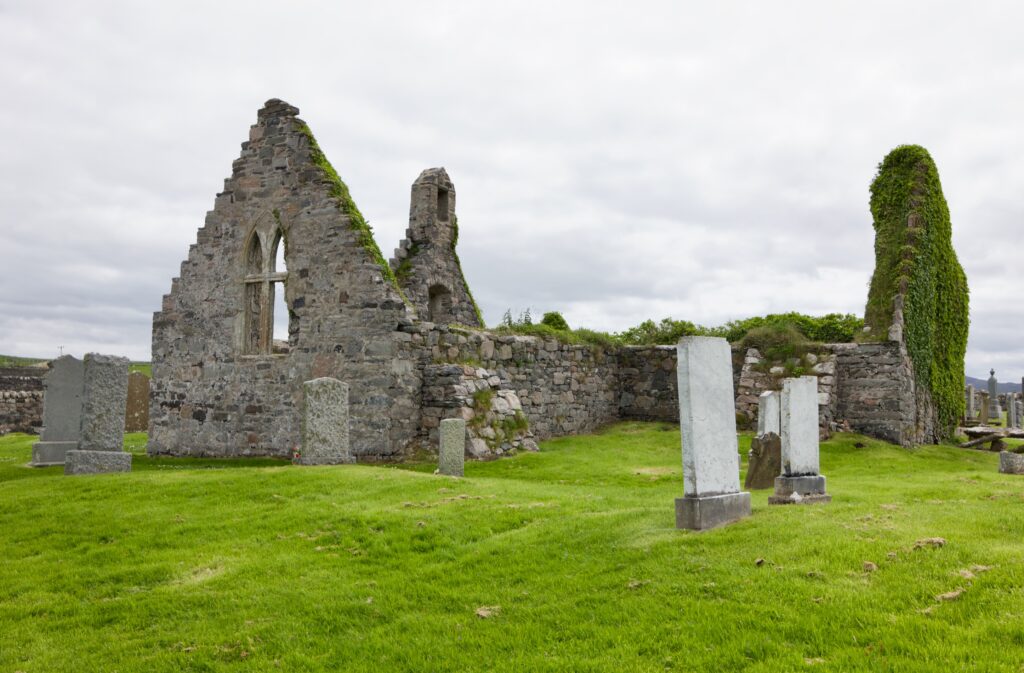
The first documented record of a church or monastic site at Balnakeil is in the 13th century, when it was assigned the duty of supplying ‘light and incense for the cathedral church’, meaning the cathedral at Dornoch on the east coast. The present building dates from 1619, and a north aisle was added in 1692. According to Historic Environment Scotland, until 1724 it was the parish church of Durness, Tongue and Eddrachillis – a wide area, stretching for at least 12 or 15 miles to the east and as far as Assynt in the south, which must have meant a challenging journey for worshippers travelling on foot. It remained in use until about 1814, when services were transferred to a more modern church in Durness.
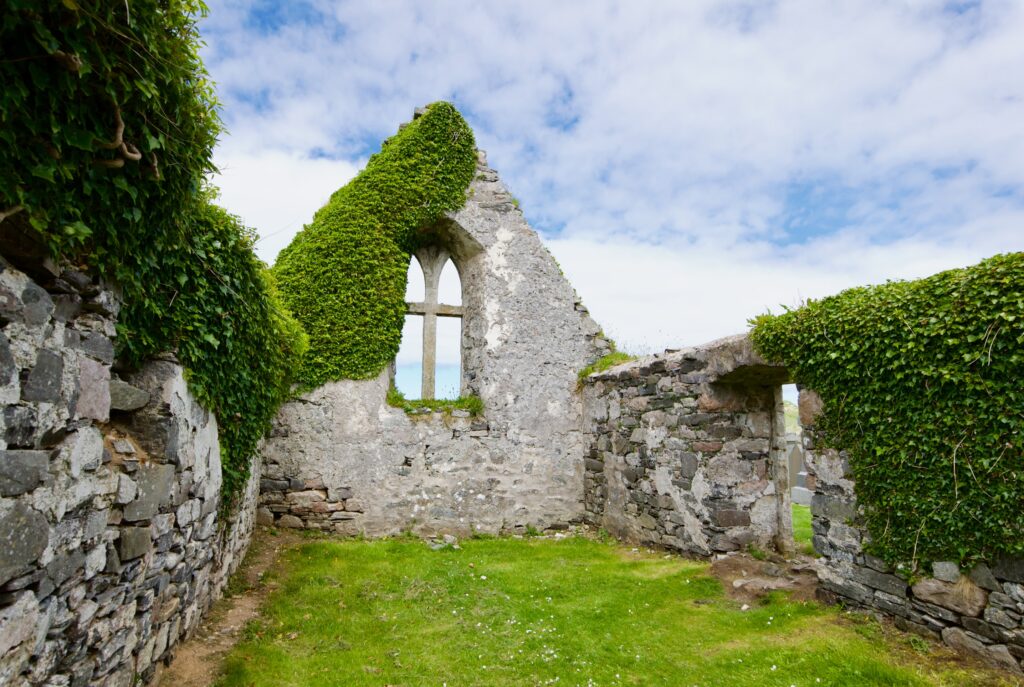
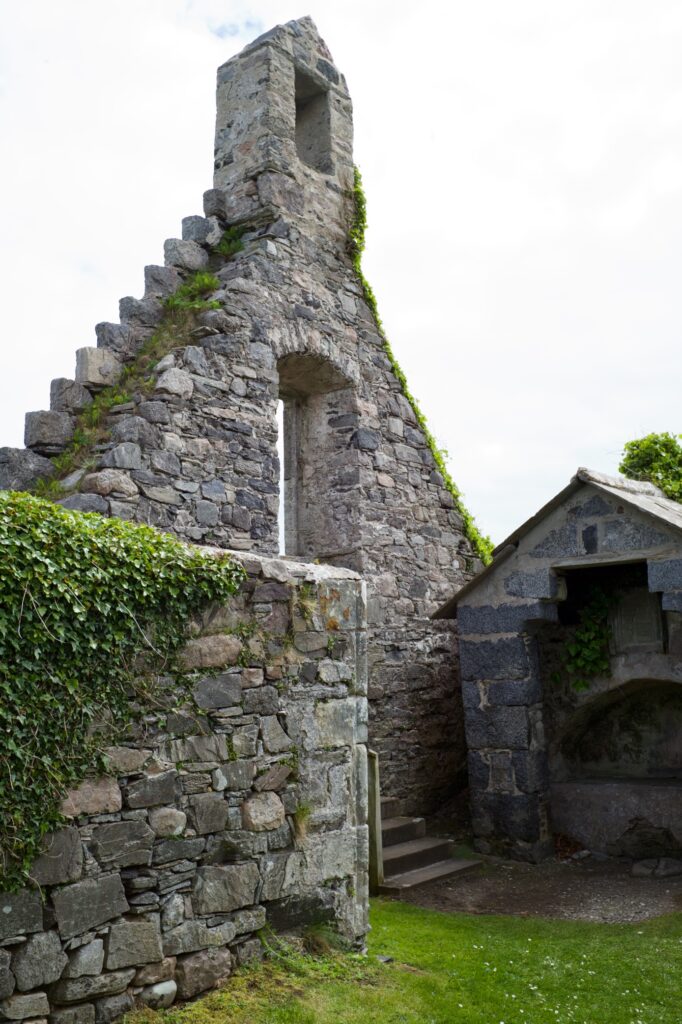
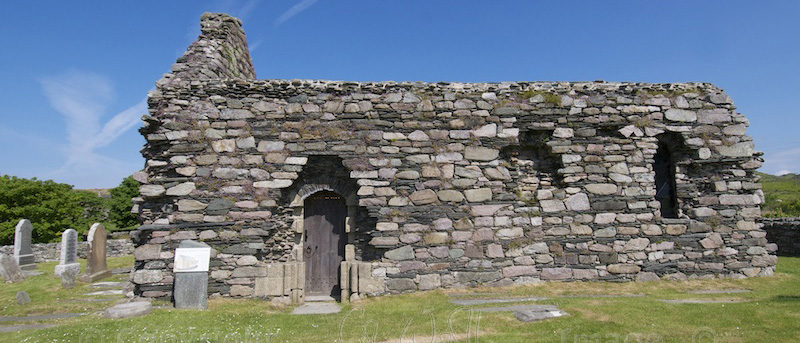
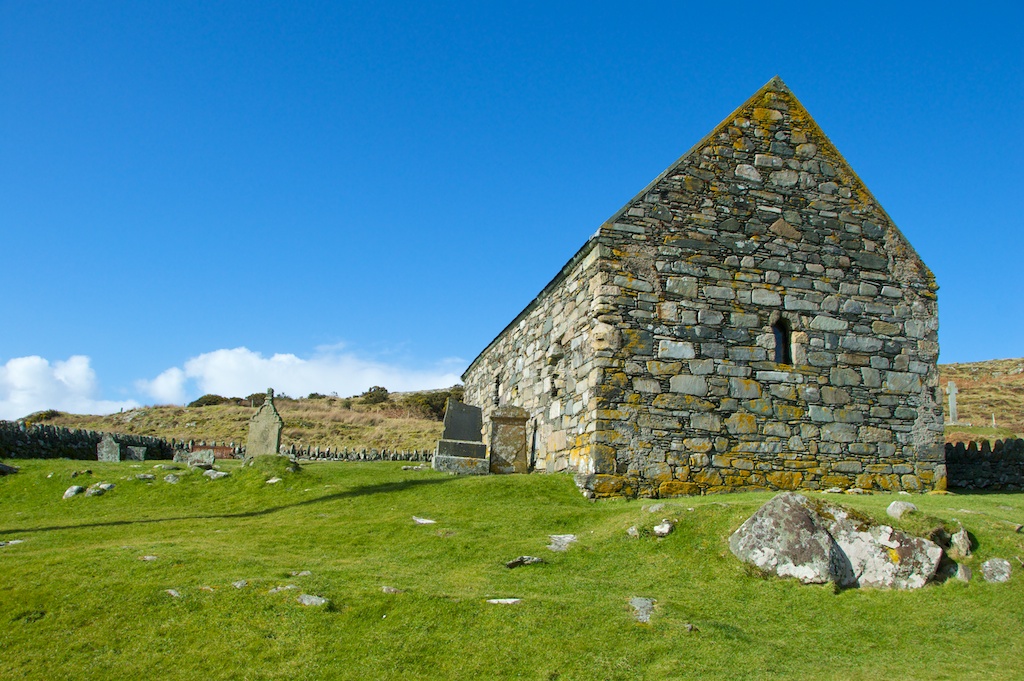
The crow-stepped east gable with belfry above
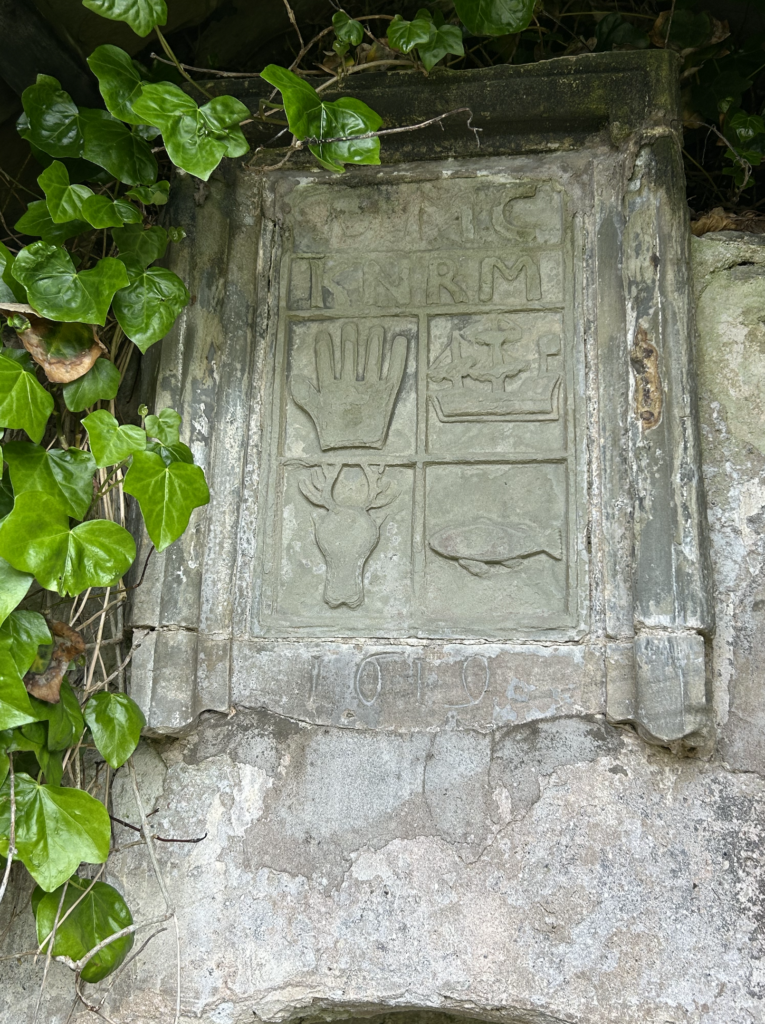
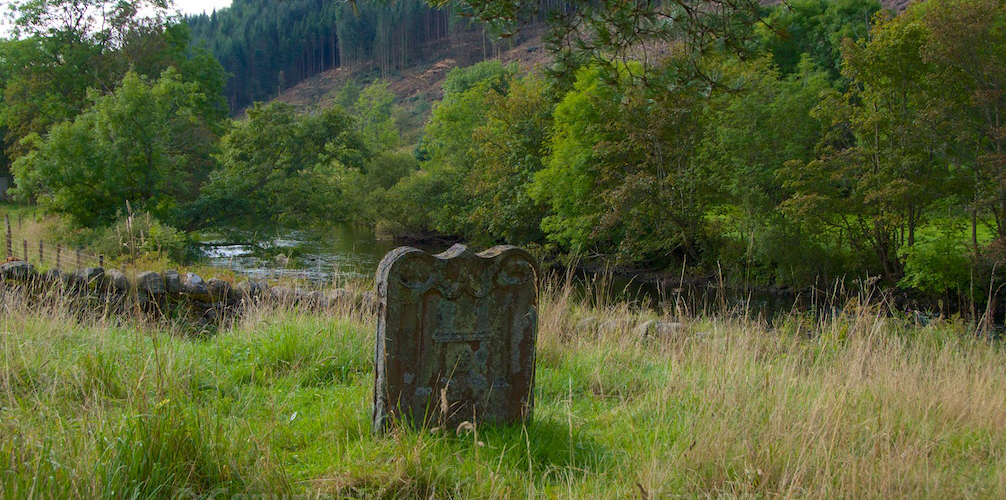
Partly swathed in ivy, the roofless walls still stand to the tops of the gables, crow-stepped with a simple belfry above the east gable. Inserted into the south wall is the 17th century tomb of a notorious local man who went by a confusing array of names: Donald or Duncan Mackay, Macleod, MacMurdo, MacMurchie, MacMurcho, Makmurchou or MacMorroch. He is reputed to have served the chiefs of Clan Mackay by disposing of their enemies and conveniently dropping their bodies into the depths of Smoo Cave, just along the coast. It’s said that he wished to be buried inside the church, but because of his crimes he was relegated to the wall.
An inscription on the tomb reads:
Donald Makmurchov hier lyis lo
Vas il to his freind, var [worse] to his fo
Trve to his maister in veird and vo.*
* The translations I’ve seen give ‘wealth’ or ‘prosperity’ for ‘veird’ and ‘woe’ for ‘vo’. If you think this is incorrect, please let me know in the comments.
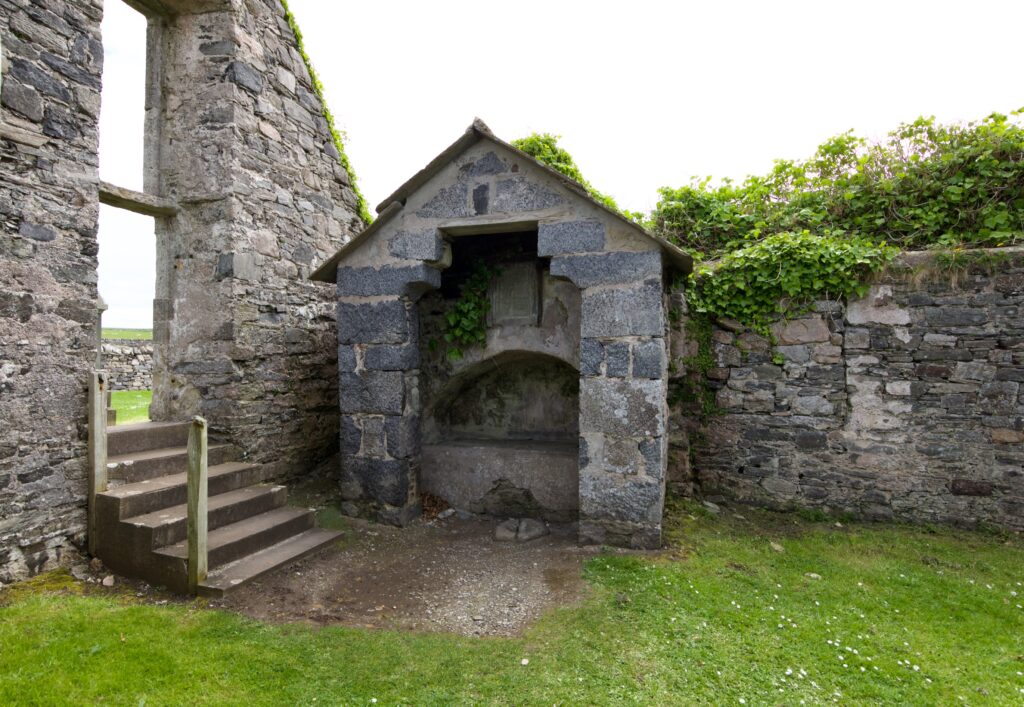
Above and below: Donald MacMurcho’s tomb, now protected by a recent stone-built shelter
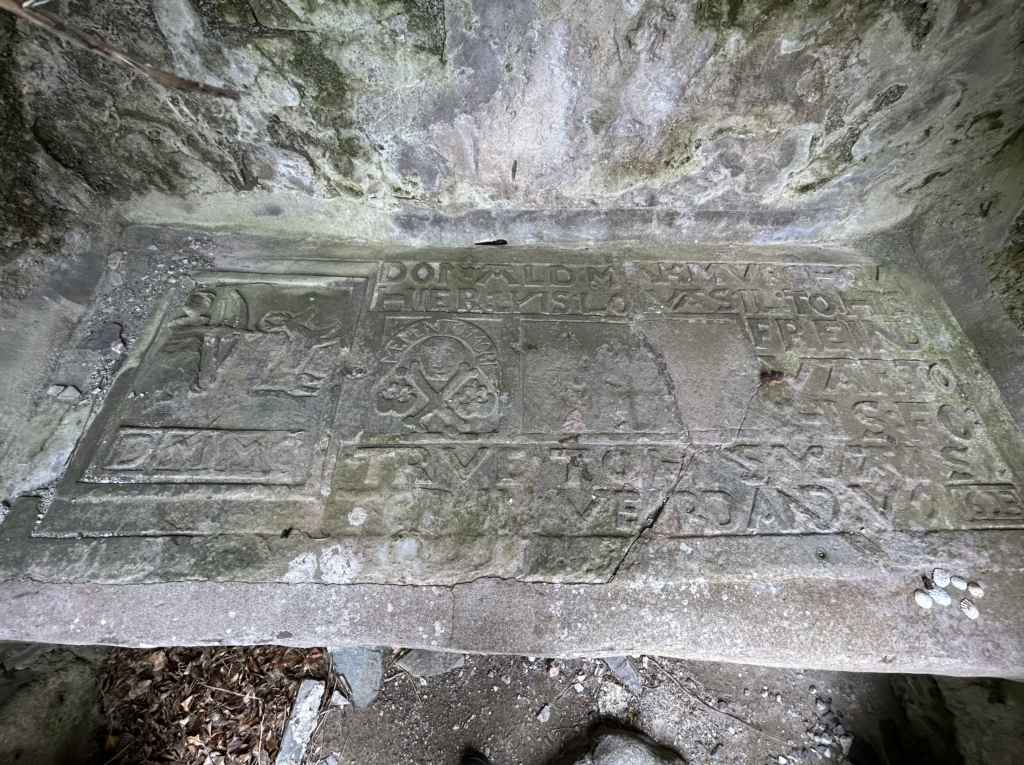
It was a cool, blustery day when we wandered around the chapel and the graveyard. The building feels empty and impersonal, but I’m sure wrens and other small birds must nest in the ivy, singing their own songs against the changing rhythm of wind and tide.
Buried in the graveyard, and commemorated with an impressive stone, is an 18th century Gaelic poet called Rob Donn Mackay (‘Donn’ means ‘brown-haired’). Rob came from Strathmore, about 15 miles to the south-east of here, and he worked as a cattle herdsman and drover. His work was entirely oral because he did not read or write; he composed over 200 poems and songs about his beloved Mackay country.
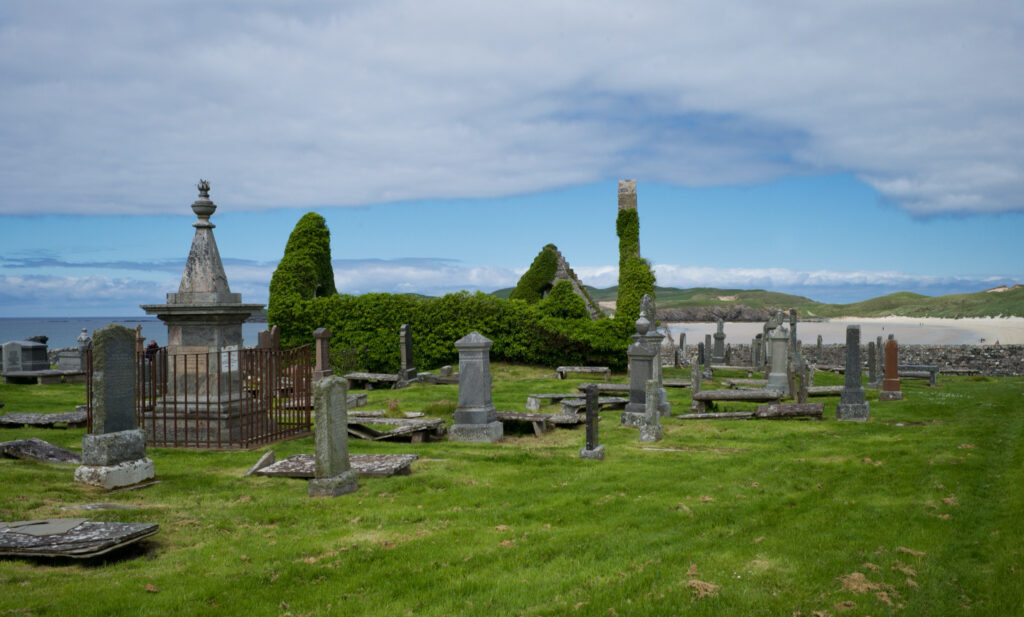
The graveyard, with Rob Donn’s monument (fenced) on the left
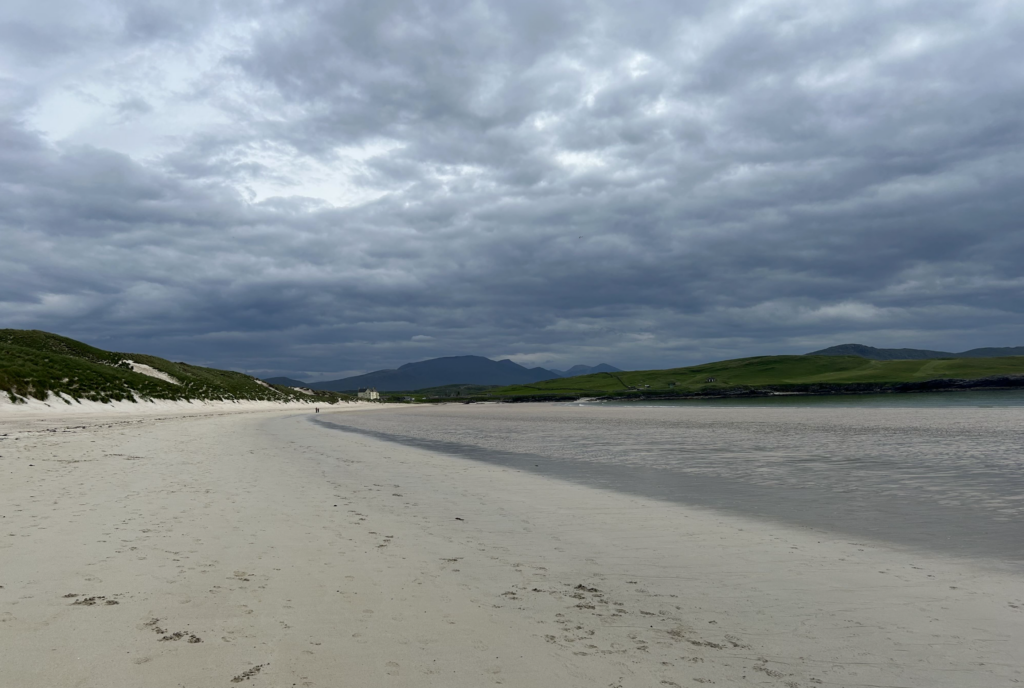
Looking back towards Balnakeil House and chapel from the beach
An information sign on the lonely road through Strathmore – a strong contender for the least-frequented information sign in the entire British Isles – gives an insight into Rob Donn’s legacy. It says:
‘Rob Donn lived most of his life in this strath, first at Allt na Caillich (burn of the old woman), then at the home of Iain mac Eachainn in Muiseal, and later with his own family at Bad na h-Achlais. This is where he composed his early love songs and political verse. To the southeast is Mudale, where the Reay Country cattle were gathered for the long trek to the markets in the south. And to the southwest is Gleann Gallaidh (Glen Golly), praised in his best-known song.’
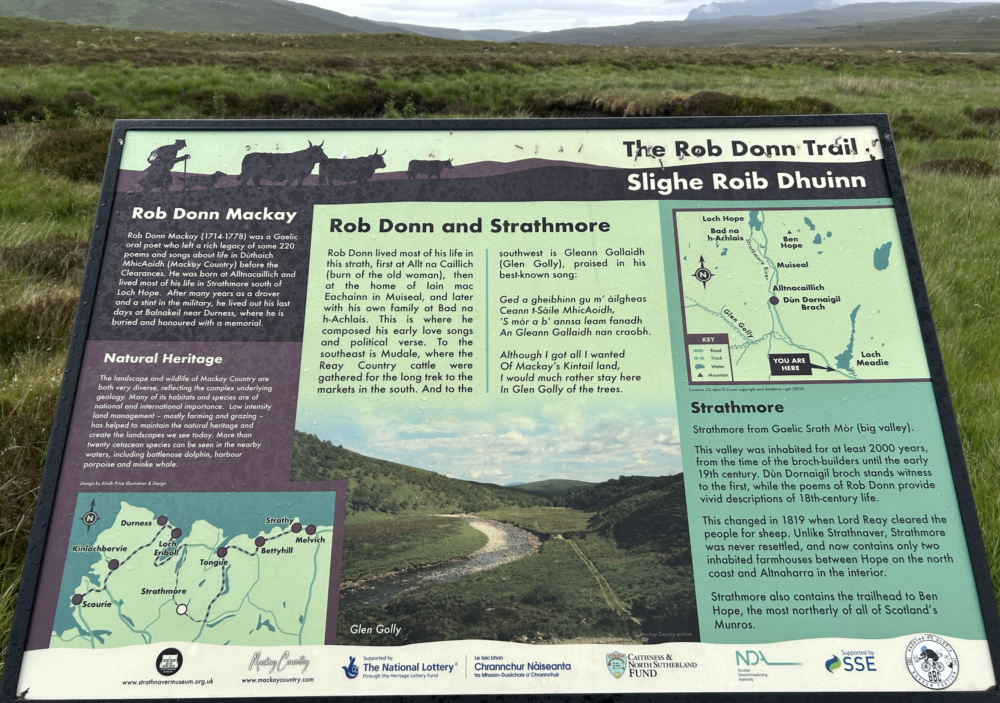
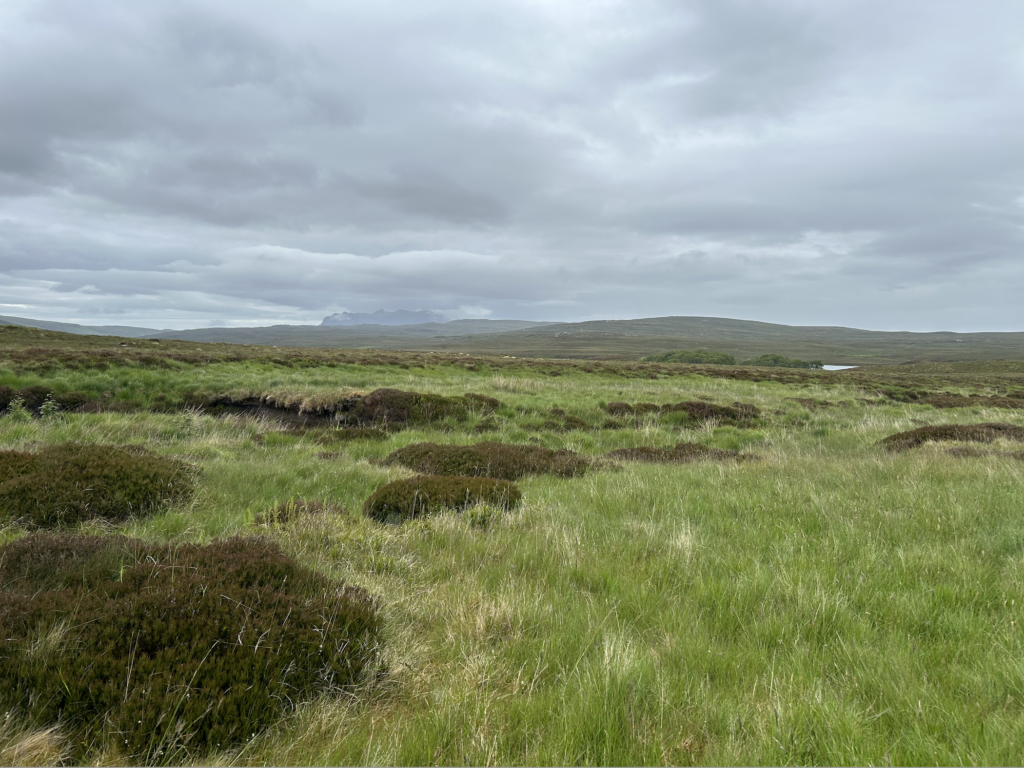
The information sign (above) and the landscape that it overlooks (below)
Rob Donn’s song of Gleann Gollaidh is described as ‘a song of gaol-duthcha’ or a love of homeland. Here are two of the verses:
Ged a gheibhinn gu m’ àilgheas
Ceann t-Sàile MhicAoidh,
’S mòr a b’ annsa leam fanadh
An Gleann Gallaidh nan craobh.
Though I might get to my desire
Mackay’s Kintail
More I fancy staying
in Glen Golly of the trees.
Fonn diasach, ’s mòr a b’ fhiach e
Gu fiadhach ’s gu nì,
Aite sìobhalt ri dioneann
Is nach criothnaich a’ ghaoth.
Bountiful land, much of its value
For stalking and cattle
An agreeable place in time of storm
In which the wind will not shudder.’
Out of interest, it seems that the Kintail land of Clan Mackay was around Tongue, on the coast. Gleann Gollaidh or Glen Golly is a remote glen whose river runs into Strathmore, beneath Ben Hope, its headwaters draining from the slopes of Foinaven and neighbouring hills that are still only accessible via walkers’ and stalkers’ tracks.
Since this story has taken us from Balnakeil to Strathmore, my next post will be about a place in that glen, which was the main reason why we were driving down that extraordinary road in June this year.
–
Reference
- John Marsden, Sea-Road of the Saints
- Saints in Scottish Place-Names
- Dictionary of Irish Biography
- Highland Historic Environment Record: Balnakeil Church and graveyard
- Historic Environment Scotland: Durness Old Church, Balnakeil
- Applecross Heritage Centre
- Places of Worship in Scotland
- Transactions of the Gaelic Society of Inverness, 1871
Images copyright Jo and Colin Woolf


12 Comments
Simon
John Lennon Aunt is buried in the graveyard too – Elizabeth Parkes
Jo Woolf
I didn’t know that! I’ve just been reading about John Lennon’s connection with the area. Apparently he used to have holidays in Durness as a child, and when he came back as an adult he drove his car off the road somewhere near Tongue, to avoid an oncoming vehicle.
Bob Hay
If that isn’t Ultima Thule Jo I don’t know what is.
Jo Woolf
Haha, it feels like that, Bob! Maybe St Maelrubha went there by sea, because it was easier. He certainly seems to have mopped around Scotland at a fair rate. I’d love to see what it looked like back then.
do3506f021b084c
Visited several times, the lonely and exposed location is special. After one visit I was telling one of our neighbours about the chuch and graveyard. I hadnt given it a thought, but his name was Ian Mackay. He had never been there, but had traced his family tree back to several occupants of the cemetery. Plans were made to visit but he sadly passed away. So it still has a extra special feel for me. On another note….the last time we were there was a makeshift craft centre in some old military huts. We bought a piece of glassware.
Jo Woolf
How sad that he never managed to visit. It’s a very atmospheric spot, and I’m sure he would have felt very much at home. The craft centre is still there, and there is a glassmaker – I don’t know if it would be the same one!
Finola Finlay
Gosh, there isn’t a place you can go in Scotland that isn’t fascinating! Ceann t-Sàile As an Irish placename translates as Kinsale.
Jo Woolf
That’s true, and I’m sure the same can be said of Ireland! Interesting about Ceann t-Sàile/Kinsale – does it have any specific meaning?
Bob Hay.
Who knows what it was like Jo. Travel agents being what they are even then, may have advertised it as the Costa de Norte.🏖️
Jo Woolf
😂 “A true wilderness experience with excursions to visit heathen communities.”
Bob Hay.
A Londinium land developer after surveying the area on behalf of some well heeled investors, visualised the area as Europe’s future playground of the rich and famous, replacing the French Riviera and with UNESCO, Historic Environment Scotland and local tribal council approvals, the Balnakiel Church ruin integrated into a casino complex…
Forgive me Jo this is becoming farcical.
Jo Woolf
Don’t go there, Bob! 😂 I prefer your Ultima Thule scenario!