
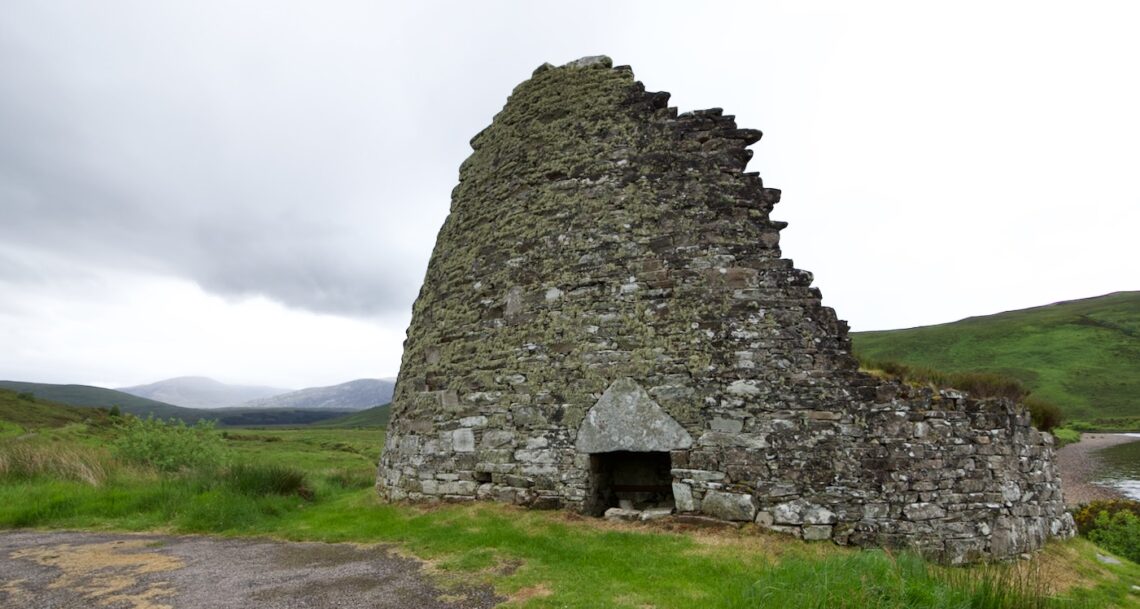
Dun Dornaigil in Strathmore
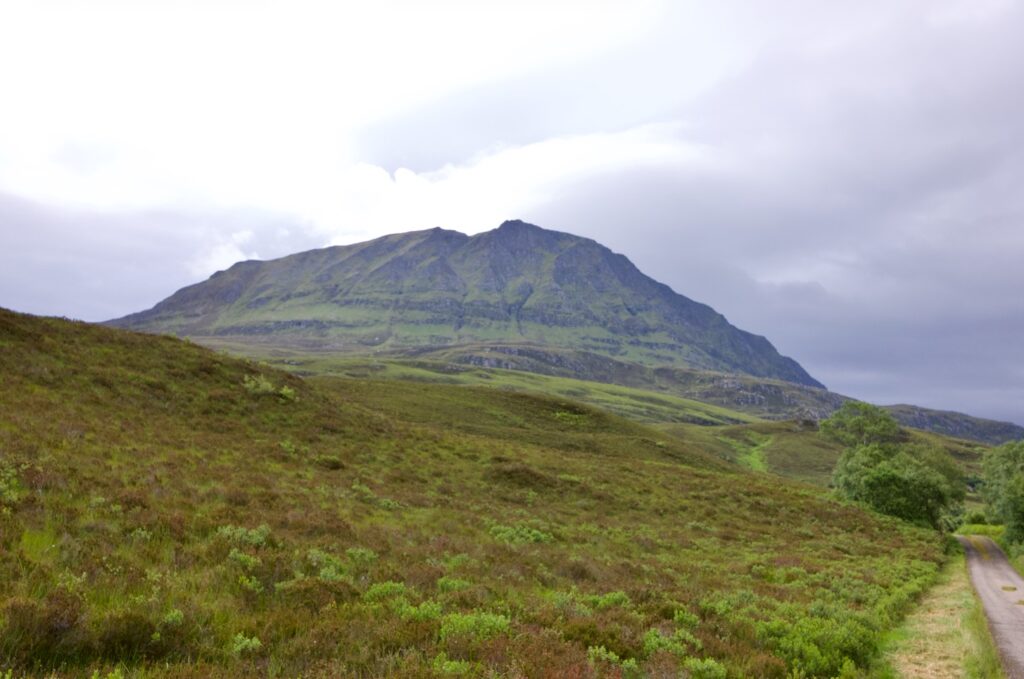
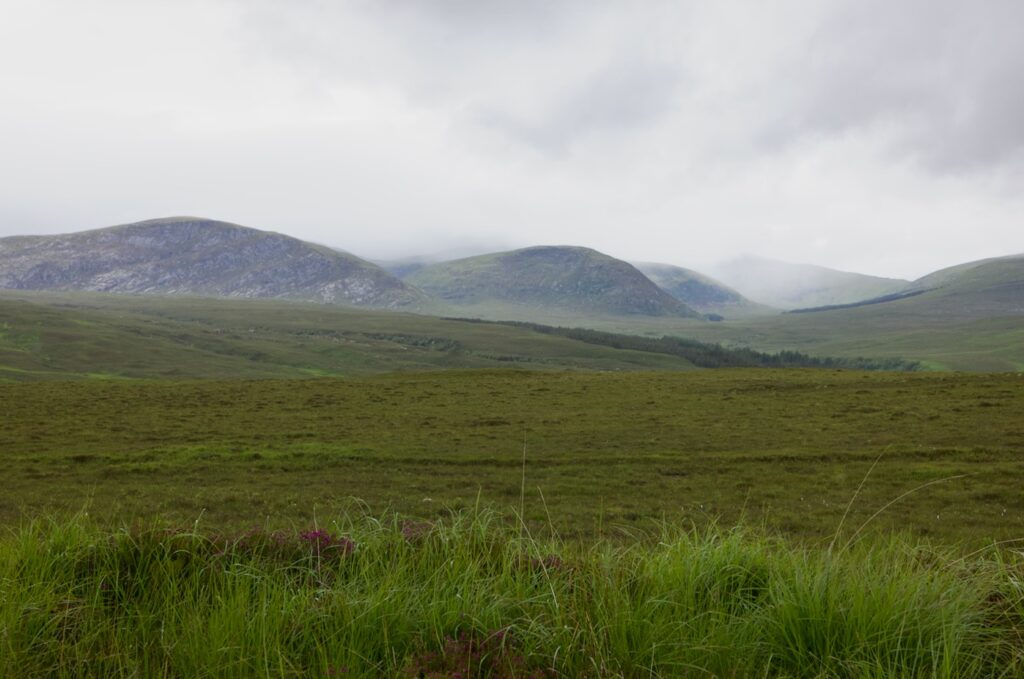
On our way home from Durness we decided to take the scenic route, which involved driving from Hope, on the north coast, to Altnaharra. This must be one of the country’s least-frequented roads, with grass growing down the middle, few passing-places, and some serious potholes. It passes beneath the dark crags of Ben Hope, with Loch Hope on your right-hand side, wild moorland in all directions, and scarcely a sign of habitation for the whole of its 20-mile length.
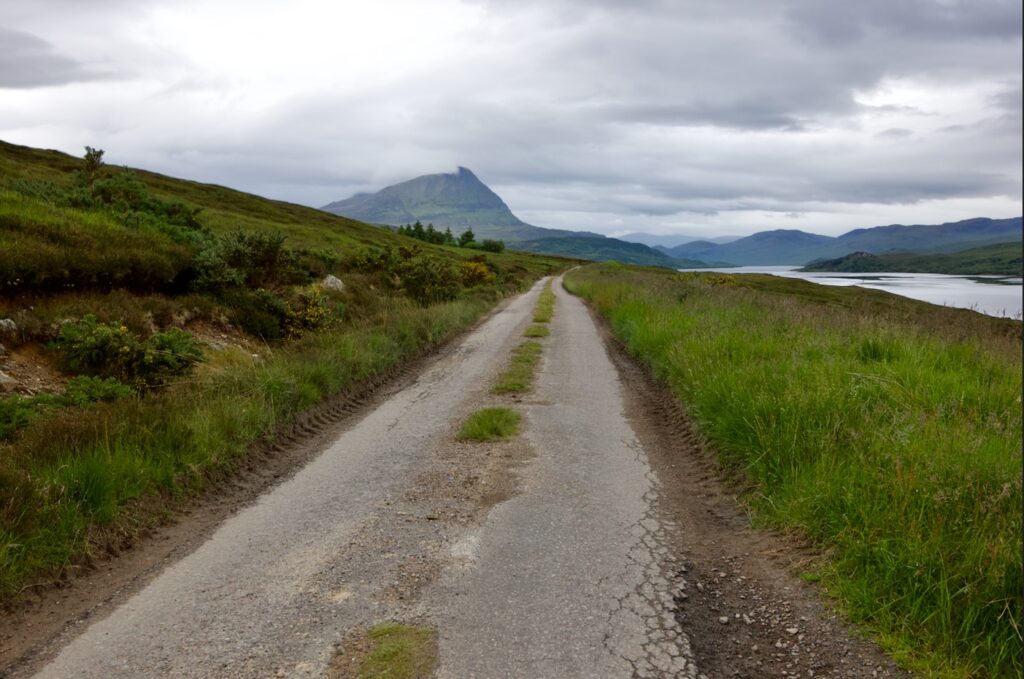
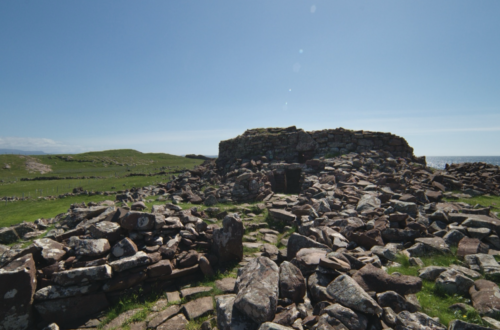
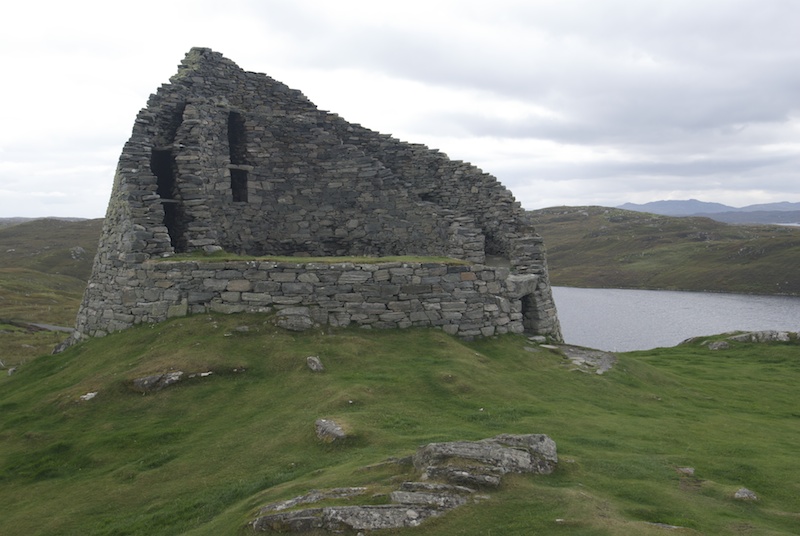
About halfway down is an astonishing Iron Age broch known as Dun Dornaigil. It was built between 2,000 and 2,500 years ago, and still stands over 20 feet high in places. According to Historic Environment Scotland, its triangular lintel is the best surviving example in Scotland.
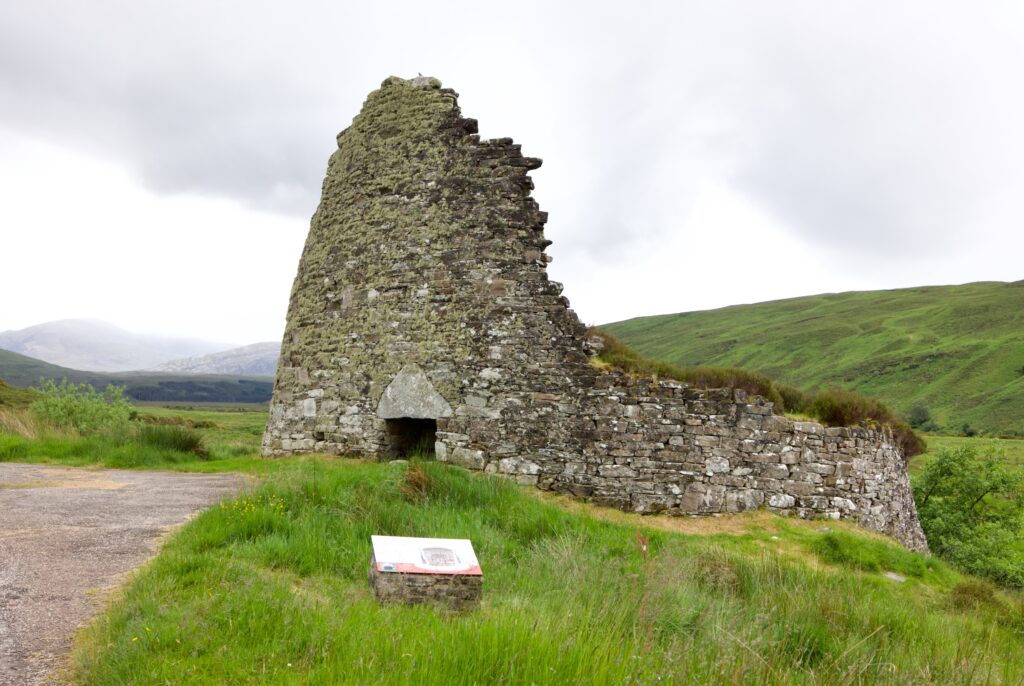
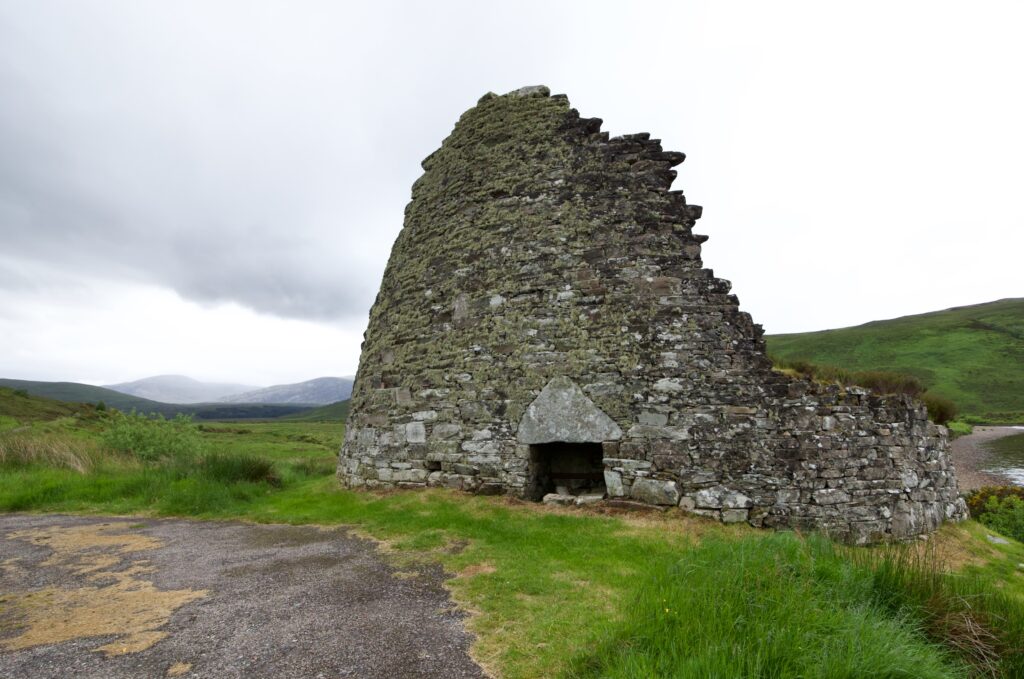
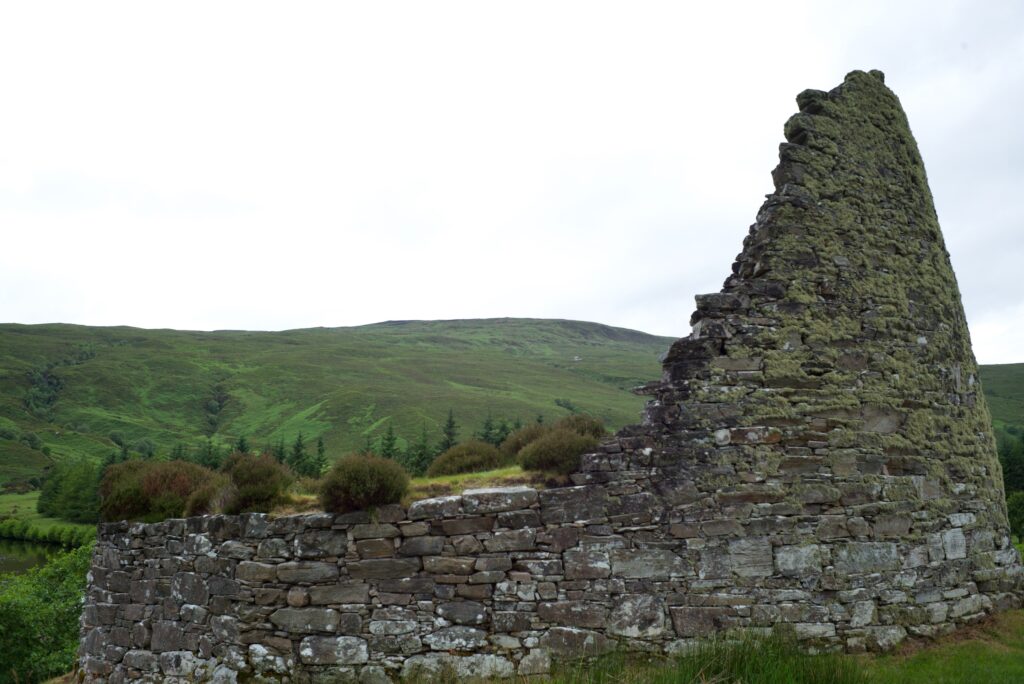
An older name for the broch is Dun Dornadilla, which takes its name from a legendary king of Scotland. King Dornadilla or Dorvidilla is said to have reigned in the third century BC; he took great delight in hunting with hounds, and passed laws relating to huntsmen and their dogs. He made peace with his neighbours, the Picts and the Britons – raising a question of where his territory actually extended to, but he was a legendary king after all – and after a reign of 28 years he died at Beregonium, a place that we’re familiar with for its own wonderful legends.
Writing in 1726, the antiquary Alexander Gordon described his visits to the brochs of Glenelg, to the south of here, and added that ‘there are two or three in my Lord Ray’s Country, one of which goes by the Name of King Dornadilla’s Castle.’ While wondering who built them, Gordon concluded that ‘they were either built as Places of Strength against foreign Enemies, or, which is still more likely, when these Parts were divided into many Clans, and they made frequent Inroads into each others Territories, those Fabricks seem to have been thus contrived for the Security of the Inhabitants thereabouts.’
Whether or not Gordon was right about the purpose of brochs, we’re still not really able to say. The current thinking is that Iron Age society in the north of Britain may have been made up of relatively egalitarian groups. For this reason, brochs are believed to have had a domestic purpose, serving as homes for several generations of farming families. (There’s a more detailed look at brochs, their structure and purpose, in my post on Clachtoll broch.)
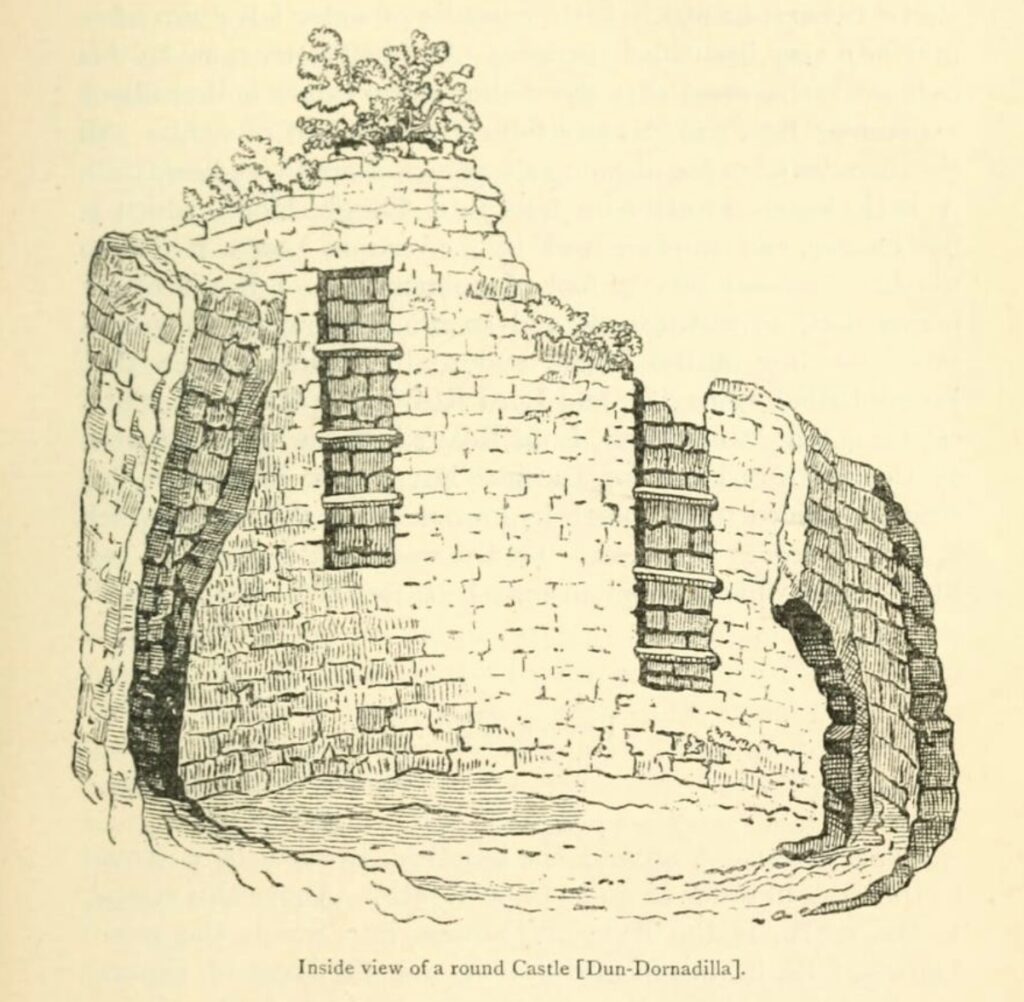
Another 18th century visitor to north-west Scotland was the Right Reverend Dr Richard Pococke, Bishop of Ossory and Meath in Ireland. Pococke was a seasoned traveller in Europe and the Middle East, and he visited Scotland twice – in 1747 and 1750 – before undertaking a more lengthy tour in 1760. On 26th June of that year he wrote to his sister, Elizabeth: ‘We stopped at Strathmore, and travelled by that river to Doundor, called in the map, Dundor Nadilla; it is the most entire round castle I have seen, seeming to be perfect in one part about thirty feet high. Every tier of stone sets in on the outside about an inch.’
Pococke continued his journey northwards, admiring the many waterfalls that were flowing down from the hills after the morning’s rain. At Loch Eriboll, he sent his horses back to Thurso: ‘Over that Lough Eribol we ferried, and Lord Reay’s horses met me, and I rid three miles to Durness, Lord Reay’s house, which is situated at the south-east end of Durness Bay, where there is a fine strand bounded to the north by Farout [Faraid] Head…’ (Lord Reay’s house would no doubt be Balnakeil House, close to Balnakeil Chapel which I wrote about in my last post.)
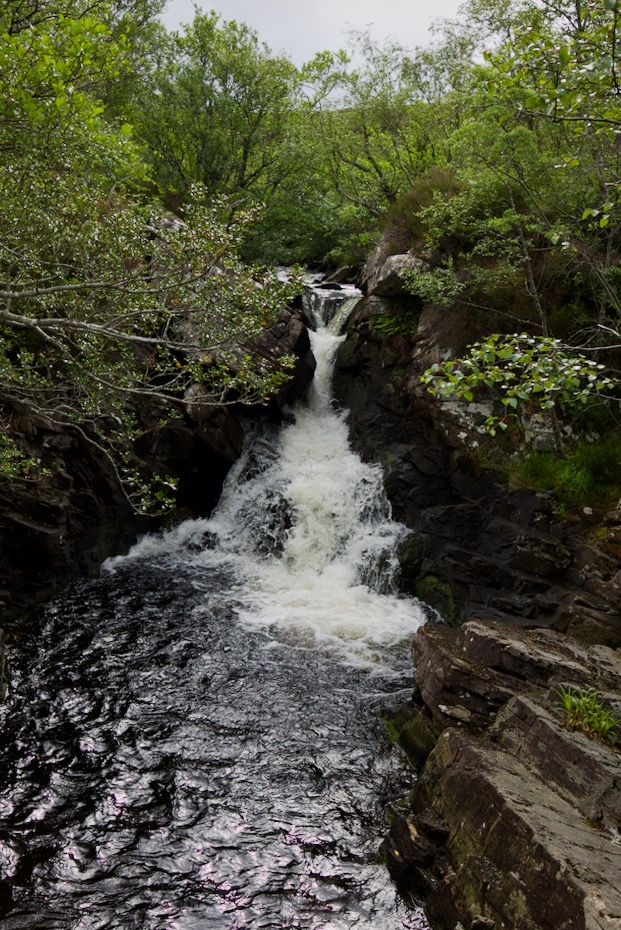
One of the many burns flowing into Loch Hope
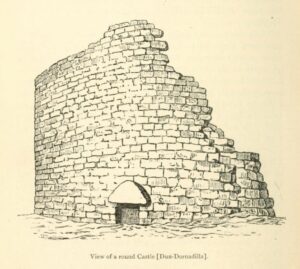
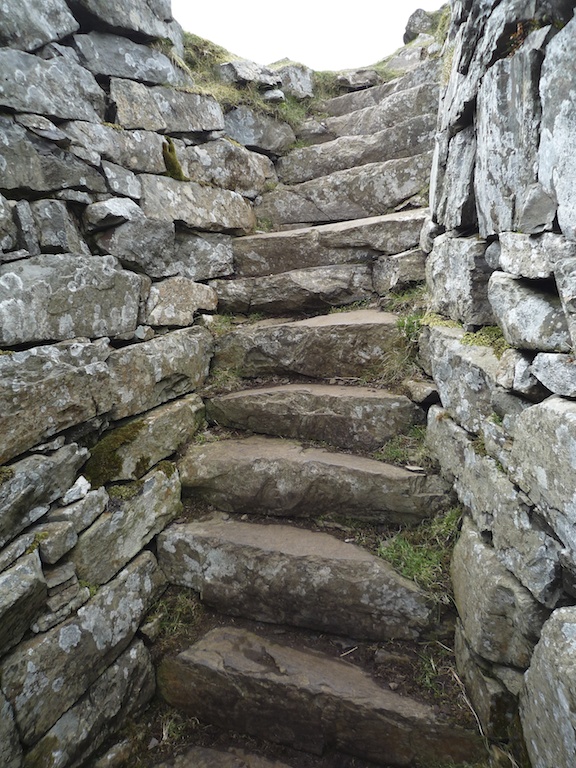
Pococke made pen and ink sketches of places he saw on his travels. In his sketches of Dun Dornaigil (below) it’s clear that more stonework was standing at that time, and details were visible on the interior wall that have since been lost or hidden. (We didn’t photograph it, but there’s a stone-built buttress against the interior wall, probably put up to stop further collapse.) Pococke could see features that he interpreted as storeys, and he calculated that ‘there might be twelve separate places for twelve families for lodgings in time of danger.’ About 20 years after Pococke’s visit, another clergyman, the Reverend Charles Cordiner, explored Dun Dornaigil and walked up the internal stairs from the first storey to the second, but he wrote that ‘those to the third seemed too confined, probably owing to many of the stones being displaced or fallen in.’
On our own visit to Dun Dornaigil we barely had time to take photos, let alone make drawings. This was because we’d been warned about ten minutes beforehand that the road was about to be closed at the other end. Prior to that, we’d been loitering happily in the absolute remoteness of it all, so it was kind of ironic that the only vehicle we met was a council truck, with a workman checking for traffic before he started digging up the road. In consequence, we leapt out at the broch – luckily it was right by the roadside – and snatched some quick photos before hurrying down to Altnaharra as though pursued by King Dornadilla’s favourite hounds. (When I say ‘hurrying’, you’re lucky if you reach 30 miles per hour).
We had to laugh about it, but at the same time we knew that sometime we’ll come back, because this whole area – Strathmore and Sutherland itself – is remarkable, with a feeling quite unlike anywhere else in Scotland. It has one of the lowest human population densities in Europe, and when you stand still you can hear, as well as see, the truth of that. (Until, I guess, they started attacking the road.) Three snipe got up from a ditch as we waited for the workmen to move a heavy roller and then we were gone, with the ‘road closed’ sign put up behind us.
‘Seven miles from ocean, in the chearful dale,
Stands the large tower, where Dornadilla reigns;
From thence, when war or civil feuds prevail,
The warriors pour into the Caithness plains.’
Traditional ballad, reproduced by Charles Cordiner
Reference
Historic Environment Scotland
Hector Boece, Scotorium Historiae (1527)
Alexander Gordon, Itinerarium Septentrionale (1726)
Richard Pococke, Tours in Scotland 1747, 1750, 1760 (1887)
Charles Cordiner, Remarkable Ruins and Romantic Prospects of North Britain (1788)
Charles Cordiner, Antiquities and Scenery of the North of Scotland (1780)
Photos copyright Colin and Jo Woolf


12 Comments
Deb Vallance
As always, your narratives have a wonderful rhythm, unfolding such interesting information and lore, and evoking the wild and complex nature of your country. Thanks for letting us tag along on your adventures!
Jo Woolf
That’s a lovely comment, Deb, thank you – I really appreciate it. I enjoy sharing them and it’s good to have your company!
Zee
Thank you so much for your wonderful descriptions and photos.
I am far away and don’t know when or if I will make it back to Scotland, but reading your missives makes me feel like I walking right beside you.
Jo Woolf
That’s so lovely to hear – I’m really touched by that. Thank you for letting me know how much you enjoy them.
Finola Finlay
I love the idea that we’re still not 100% sure what brochs were all about. And good old Pocock – that he recorded his travels in the 18th century has been been such a boon for us all.
Jo Woolf
At a time when travel was a real adventure, he did seem to revel in it! And his drawings add an extra dimension.
David Oakes
So you had to hurry 🙂 …. not something on these lonely either appropriate or possible. So long ago since we did that trip up from Altnaharra and I cannot recall the broch. But if I dig deep into the memory bank do I recall a church ruins and graveyard? No matter another good read and a reminder of the lovely Glen and river Strathmore
Jo Woolf
Thank you, David. We didn’t see any sign of a church ruin or a graveyard, but sometimes these places are well hidden or tucked away down a track.
Bob Hay.
I got a sense of deja vu Jo wih that massive triangular lintel. Convergent technology?
The Lion Gate at Mycenae.
Jo Woolf
There’s a striking similarity, Bob, although that one is certainly more decorative!
Bob Hay.
Incredibly Jo its interior has never been (recorded anyway) excavated.
Jo Woolf
That’s true, Bob – unlike Clachtoll – there’d be a lot of fallen stonework to negotiate, but it’s fascinating to wonder what lies beneath it.