
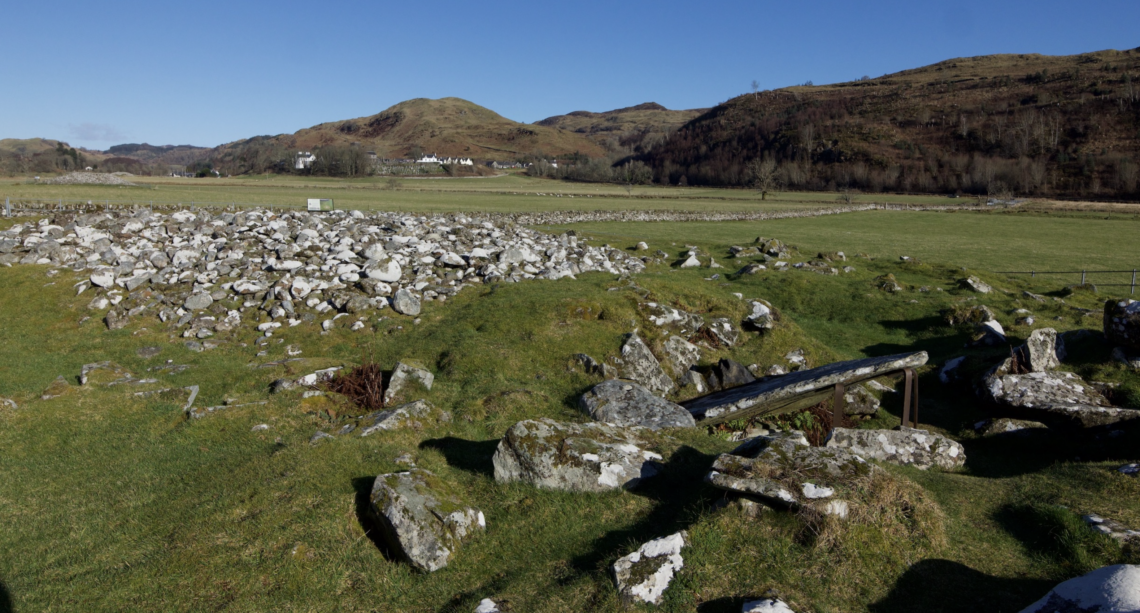
Bronze Age cairns in Kilmartin Glen
One afternoon in February, when the sky was unexpectedly cloud-free, we were in need of a local walk and took ourselves down to Kilmartin Glen, just a short drive away. Kilmartin Glen is a landscape rich in prehistoric sites, from standing stones to cup-marked rocks, and I’ve written about them often, in all seasons. We never tire of visiting these places, however, and there are still a few sites we’ve yet to explore.
Among Kilmartin’s most significant features is its ‘linear cemetery’ of Bronze Age burial cairns which stretch for more than two and a half miles down the glen; I’ve already written about Nether Largie South Cairn and Rí Cruin Cairn, which lie towards the southern end, but I’ve not yet written about the three more northerly cairns: Glebe Cairn, Nether Largie North and Nether Largie Mid Cairn.
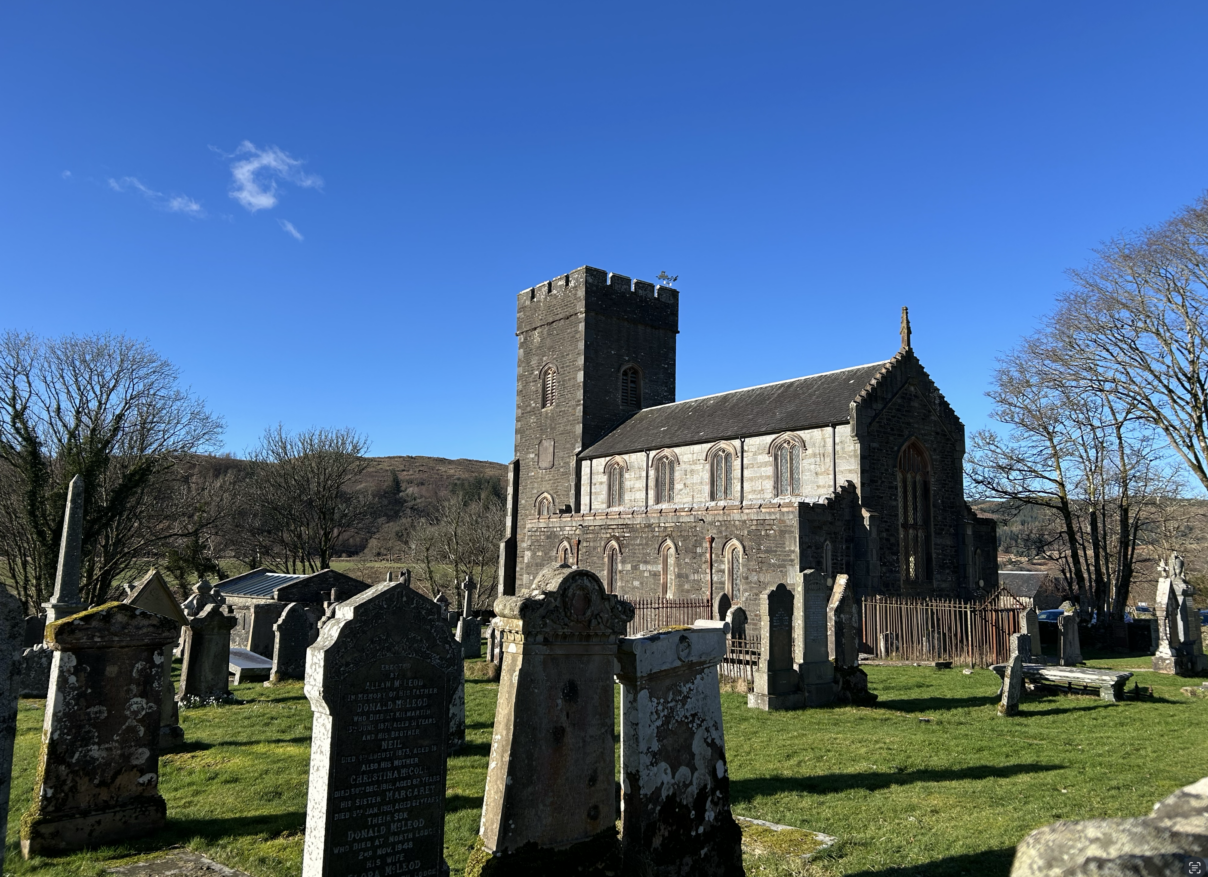
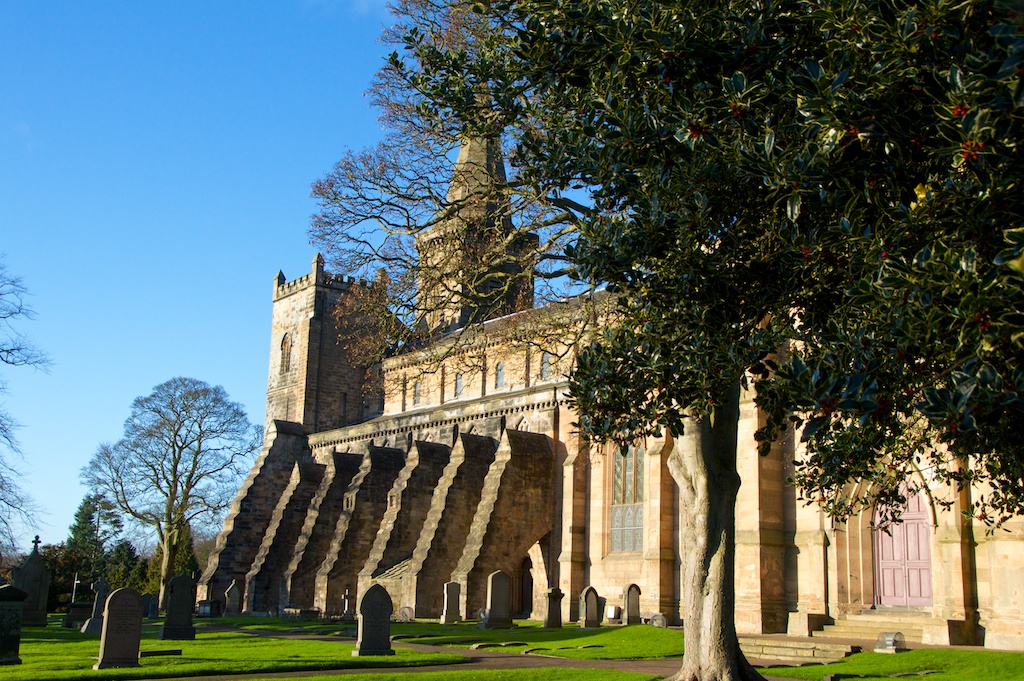
Above: Kilmartin church
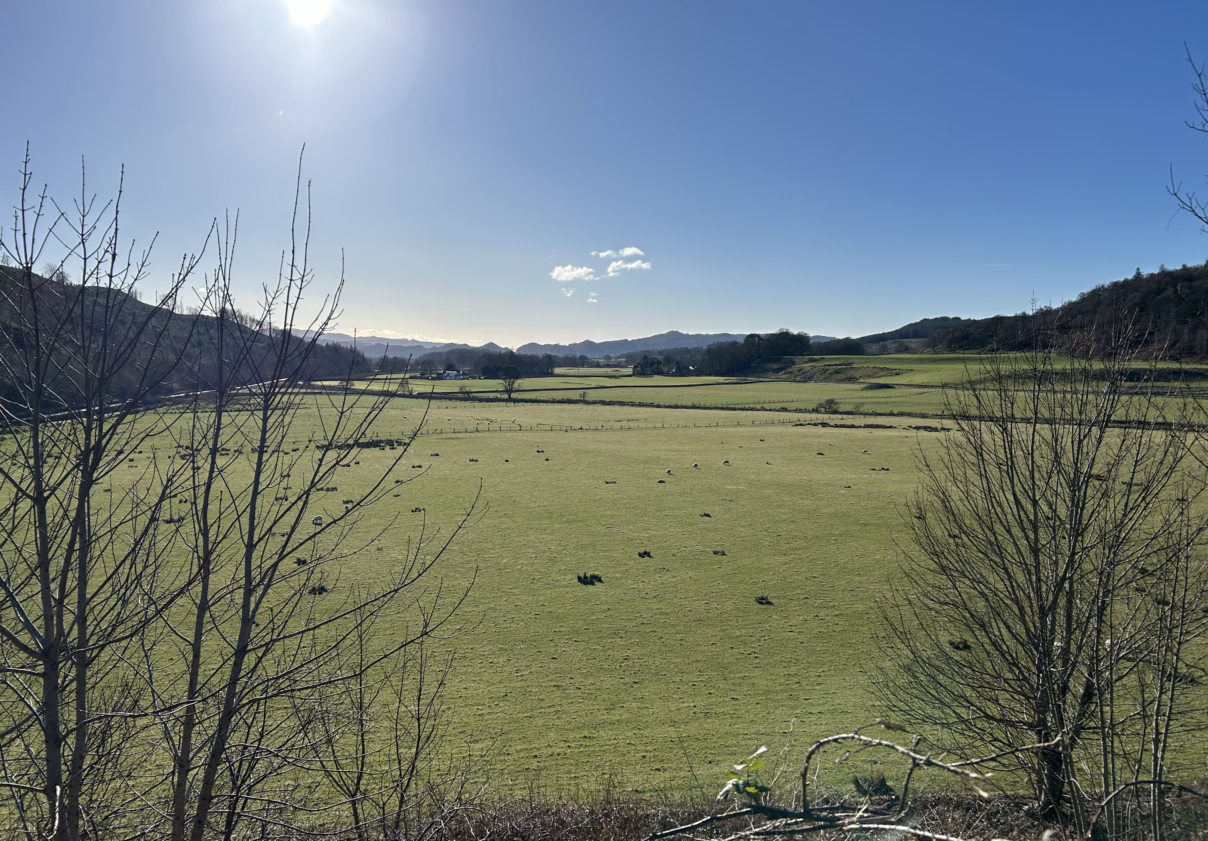
Below: looking down Kilmartin Glen and the linear cemetery from the churchyard, with North Cairn and Mid Cairn just visible where the flat fields meet a low embankment on the right
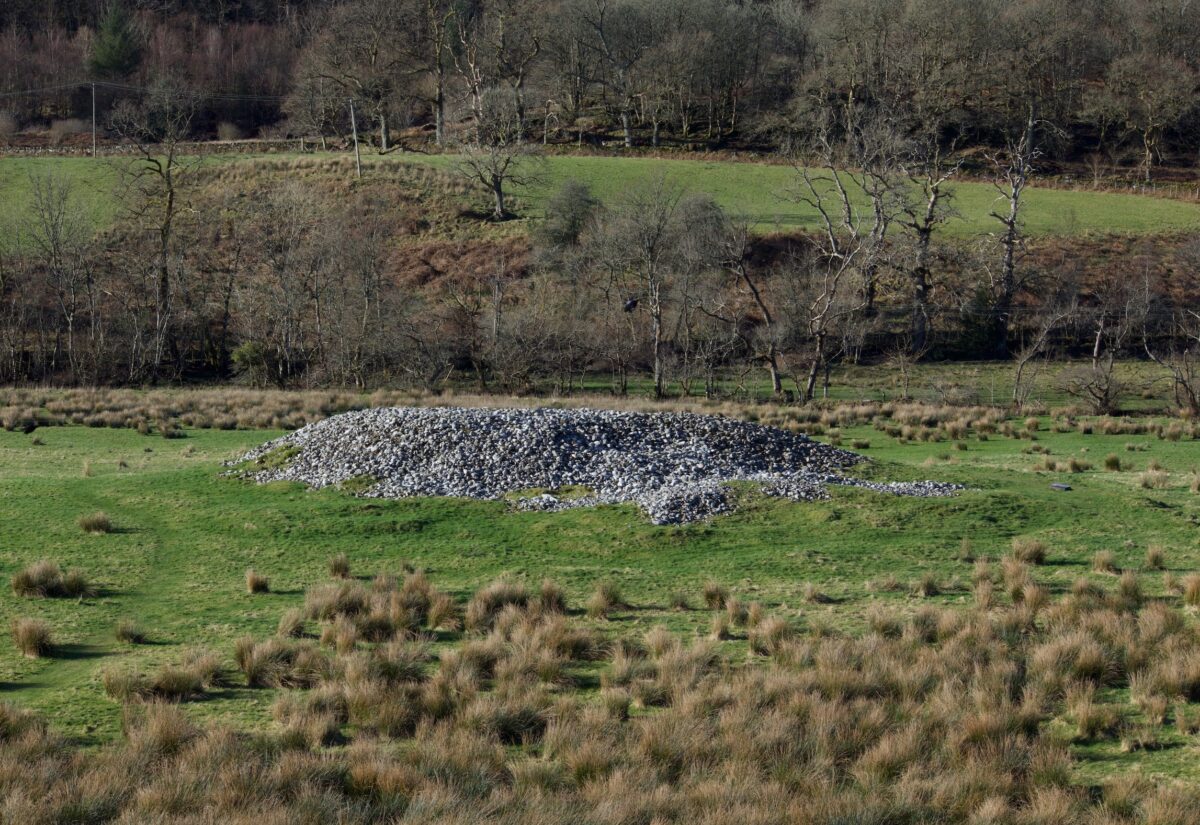
Glebe Cairn
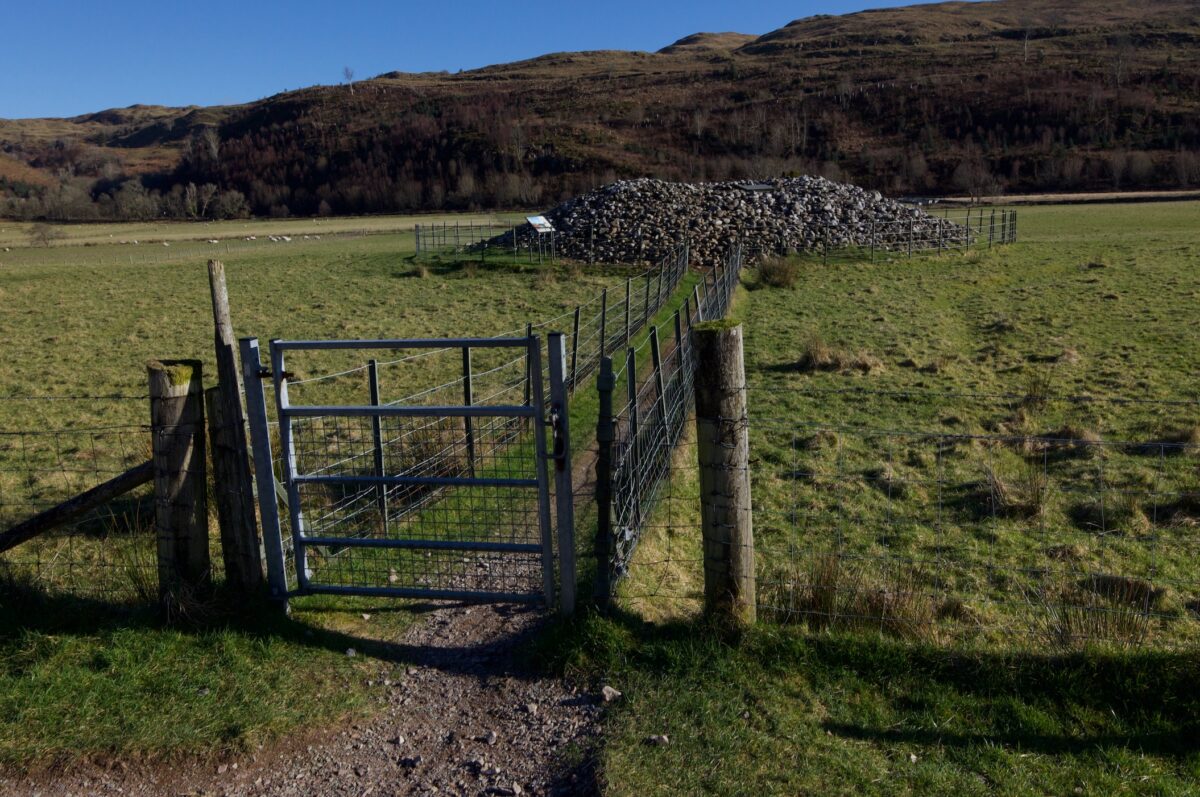
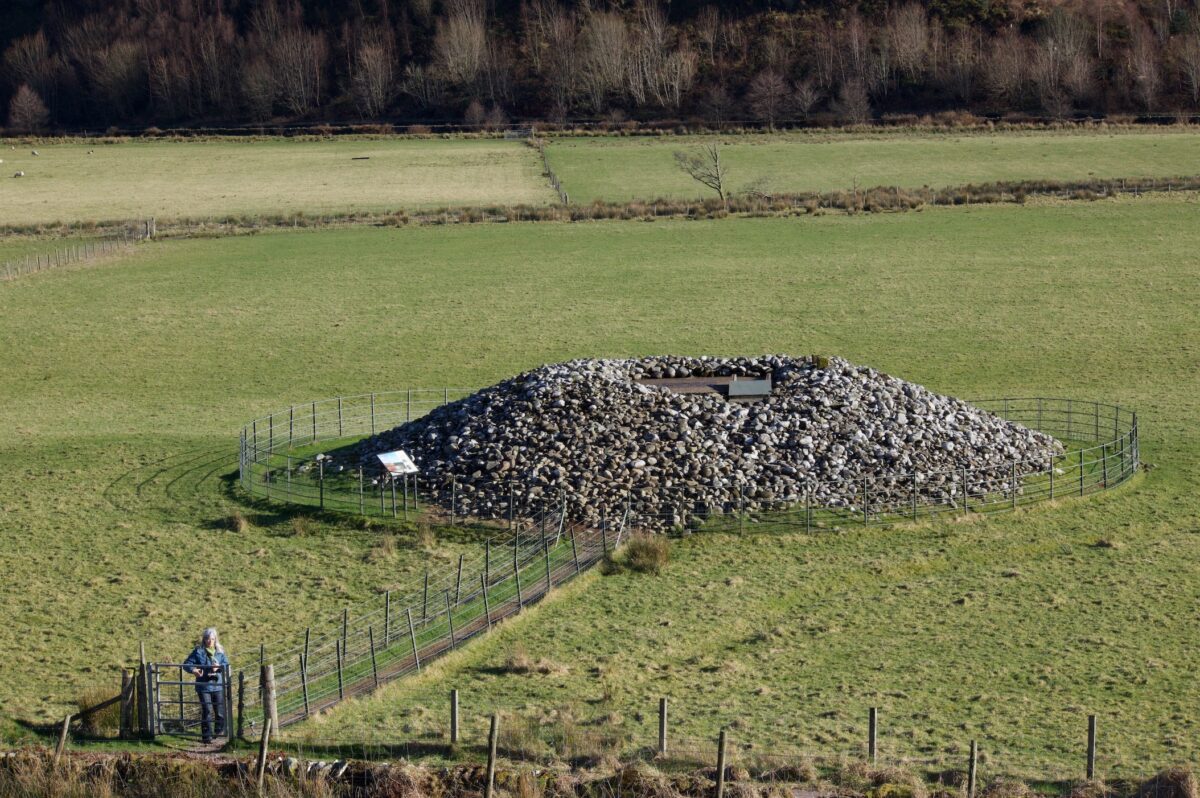
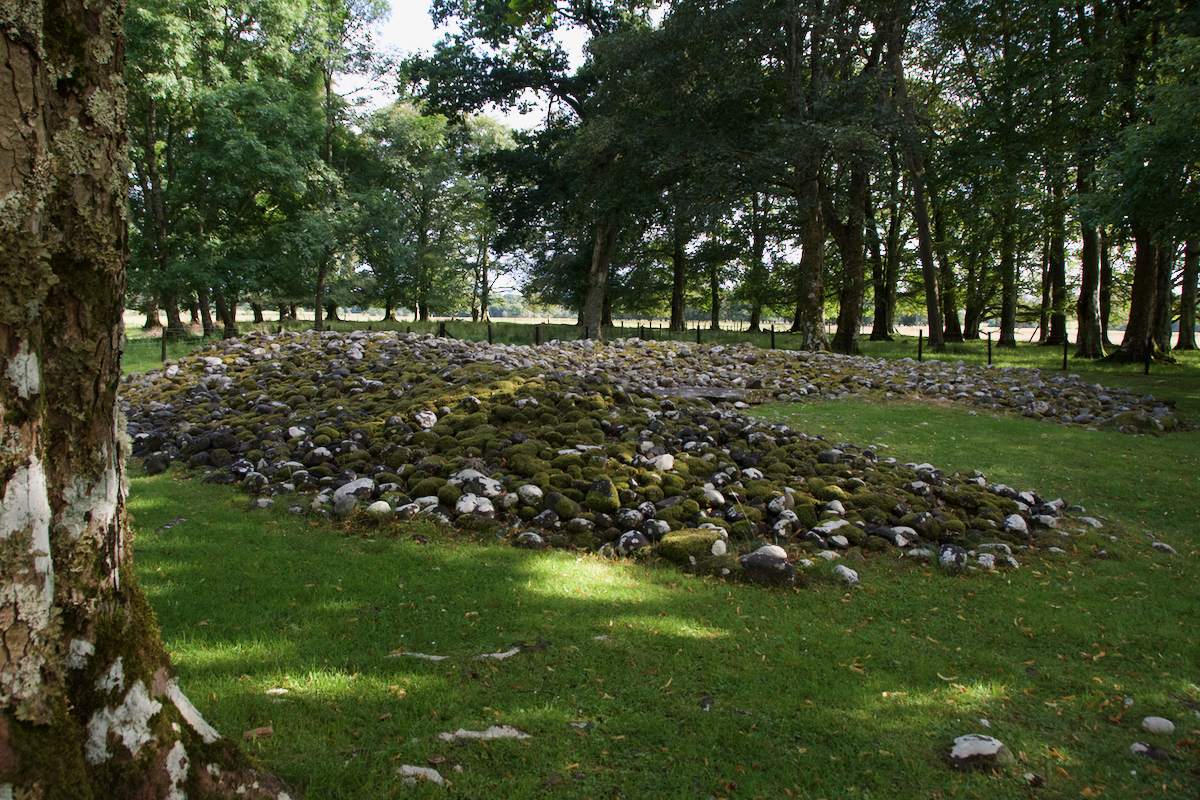
Having parked in the village, we walked a short way down the road and then turned to cross the field that lies behind Kilmartin Museum. The bright sun had very little warmth in it, and in places the grass was still white with frost. Glebe Cairn loomed straight ahead, rising to a height of about 12 feet and sprawling outwards in irregular tumbles of pale, rounded stones. Circling around it, I could see no structural features other than the heaped stones themselves. Some cairns have capstones and burial chambers exposed, but in others, like this one, they remain hidden.
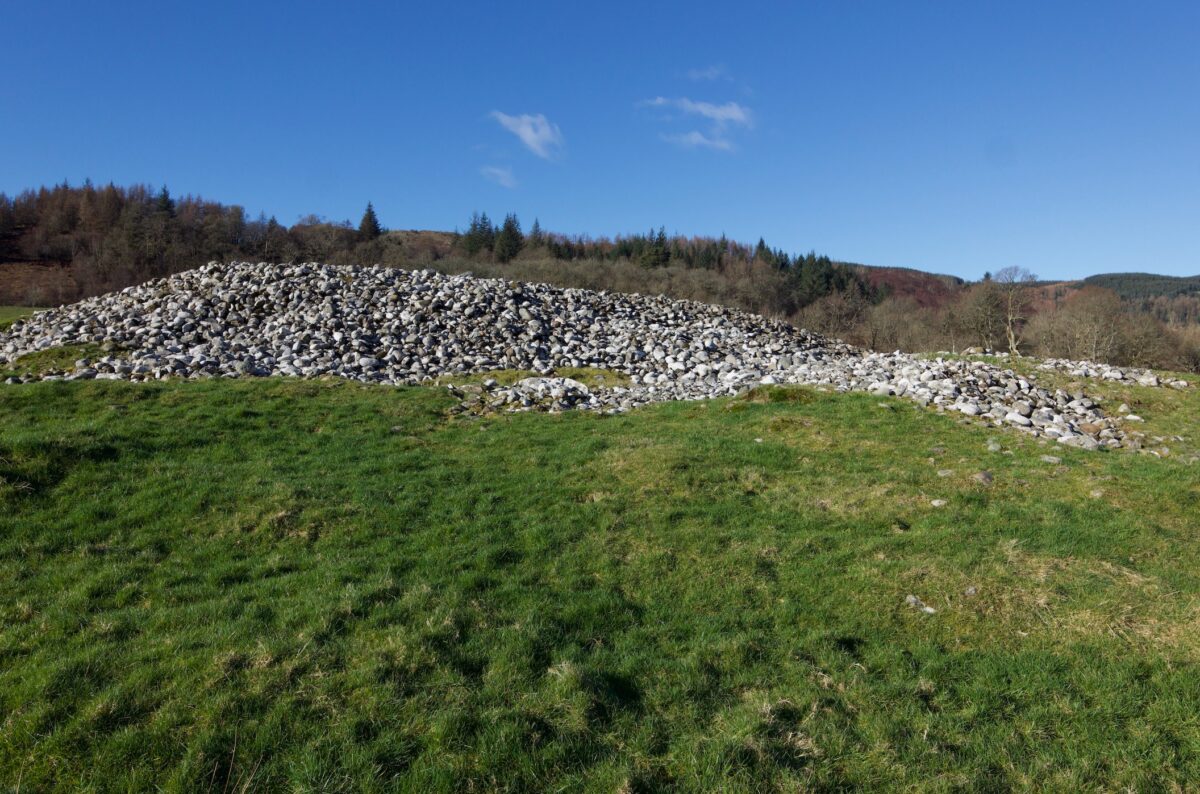
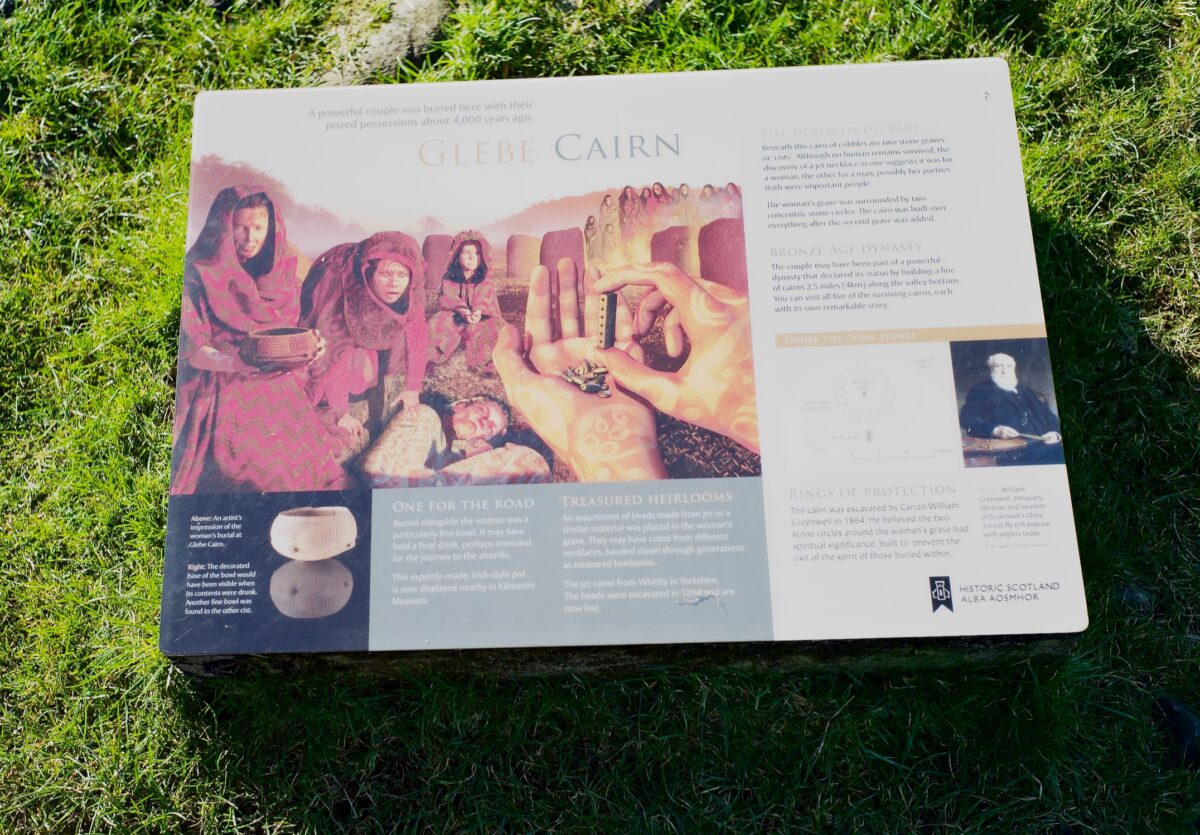
An information sign explains that two burials were made here around 4,000 years ago, and afterwards the mound of stones was raised on top of them. An artist’s impression depicts a group of women kneeling and placing objects in the grave – an earthenware bowl, and a handful of jet beads. It is the beads, discovered during an excavation in 1864, that have led archaeologists to believe that one of the graves contained a woman.
The 1864 excavation was conducted by William Greenwell, an antiquary and canon of Durham Cathedral. Greenwell had developed an interest in archaeology as a child, digging around the remains of a Roman fort on his parents’ land. Later in life he instructed the young Augustus Pitt Rivers, who became an eminent archaeologist himself, in the techniques of excavation. (Greenwell was also a keen fly fisherman, and invented a classic fly called the Greenwell’s Glory).
At Glebe Cairn, Greenwell began his explorations on the south-west side, and soon uncovered a number of large stones, about three feet high and two feet wide, standing upright and spaced apart from each other. As the excavation progressed these turned out to be a double circle of standing stones, and at their centre was a cist or small burial chamber made of four slabs set on edge, with a fifth slab to cover them. The cavity in the cist was half-filled with river gravel, and within the gravel was found an earthenware bowl, about nine inches in diameter, with geometric patterns impressed into its surface; around the outside, four pierced tabs might have been used as a means of suspension.
Along with the urn were 28 jet beads of various shapes and sizes. Jet is a natural substance – a type of lignite – which formed around 180 million years ago from the decayed and compressed remains of coniferous trees in the Araucariaceae family (of which the monkey puzzle tree is one). In Britain by far the richest source of jet is in Whitby in Yorkshire, where it occurs in the coastal cliffs. It can be worked and polished to a fine lustre, and has been used to make jewellery since Neolithic times. Historians believe that jet jewellery denoted the power and significance of the wearer.
It is thought that the beads in Glebe Cairn may have come from different necklaces, perhaps even treasured as heirlooms. Sadly, all the beads discovered here were lost in a house fire in the early 1900s. Another jet necklace, however, unearthed elsewhere in Kilmartin Glen, has survived and is in the care of the National Museum of Scotland (occasionally on loan to Kilmartin Museum).
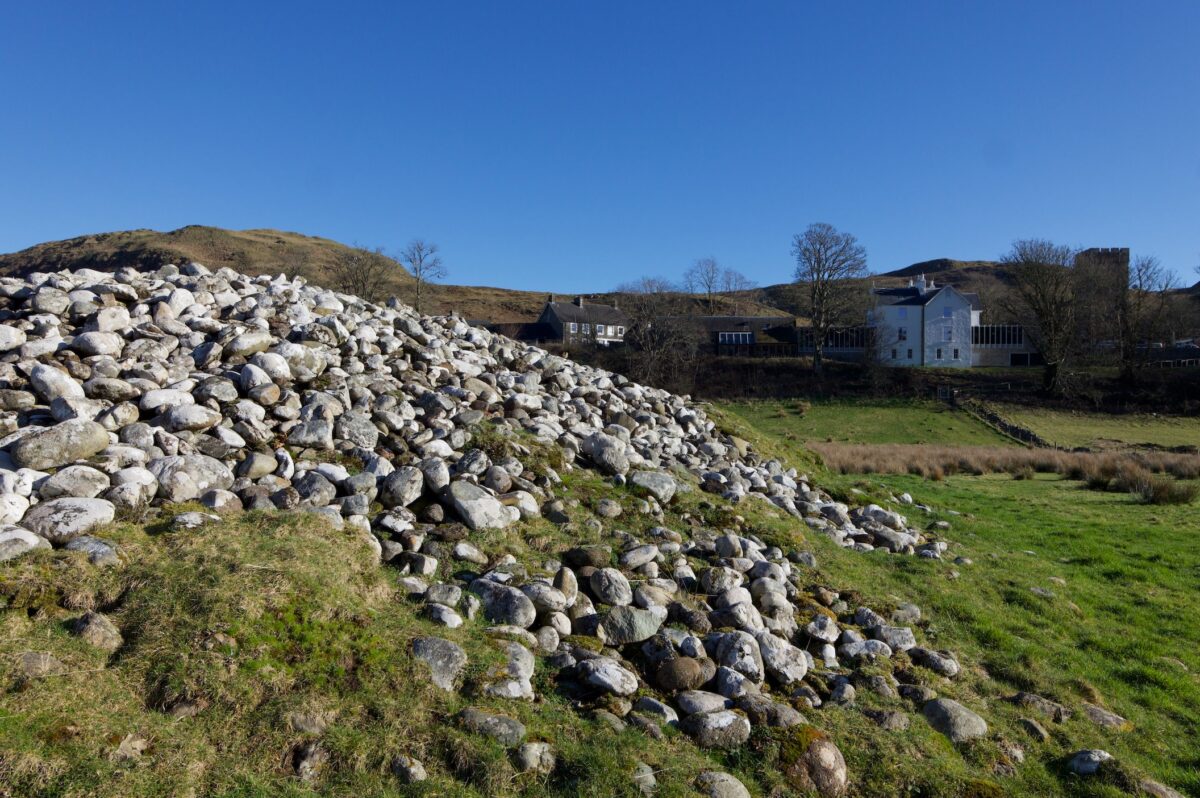
Glebe Cairn with Kilmartin Museum behind
As Greenwell worked his way into the centre of the cairn, he discovered another cist, which contained what he considered to be the ‘primary interment’. The cist was formed by a hollow sunk into the ground, lined with boulders, and was covered by a slab nine feet in length. Within it, the space was filled with gravel up to about a foot of the covering slab. Inside the gravel were found the remnants of a broken bowl, similar in design to the one in the first grave. At a slightly deeper level, two flat slabs had been laid at either end of the cist, and on them was what Greenwell described as a quantity of dark ‘unctuous matter’ and – in one case – a deposit of charcoal. He thought it probable that more than one body had been interred here, and ‘had gone entirely to decay, leaving no further trace than the dark substance which was found upon and under the flat stones.’ (It is impossible now to know whether this was the remains of a burial.)
The guidebook to the sites of Kilmartin Glen (In the Footsteps of Kings by Dr Sharon Webb) notes that Greenwell’s excavation ‘revealed various phases of use and reuse, which is typical of most of the prehistoric monuments in the Glen.’ It goes on to explain that the bowls found in Glebe Cairn have stylistic links to Ireland and are thought to have held offerings of food for the dead, perhaps to sustain them on their journey to the Otherworld. One of the bowls is considered to be among the finest of its kind in Scotland. Both are displayed at Kilmartin Museum, on loan from the National Museum of Scotland and the British Museum.
‘Glebe Cairn, and the other cairns in the linear cemetery, were built at a time when social elites had emerged and they set about emphasising their status in a number of ways, which included the construction of massive burial monuments.’
In the Footsteps of Kings
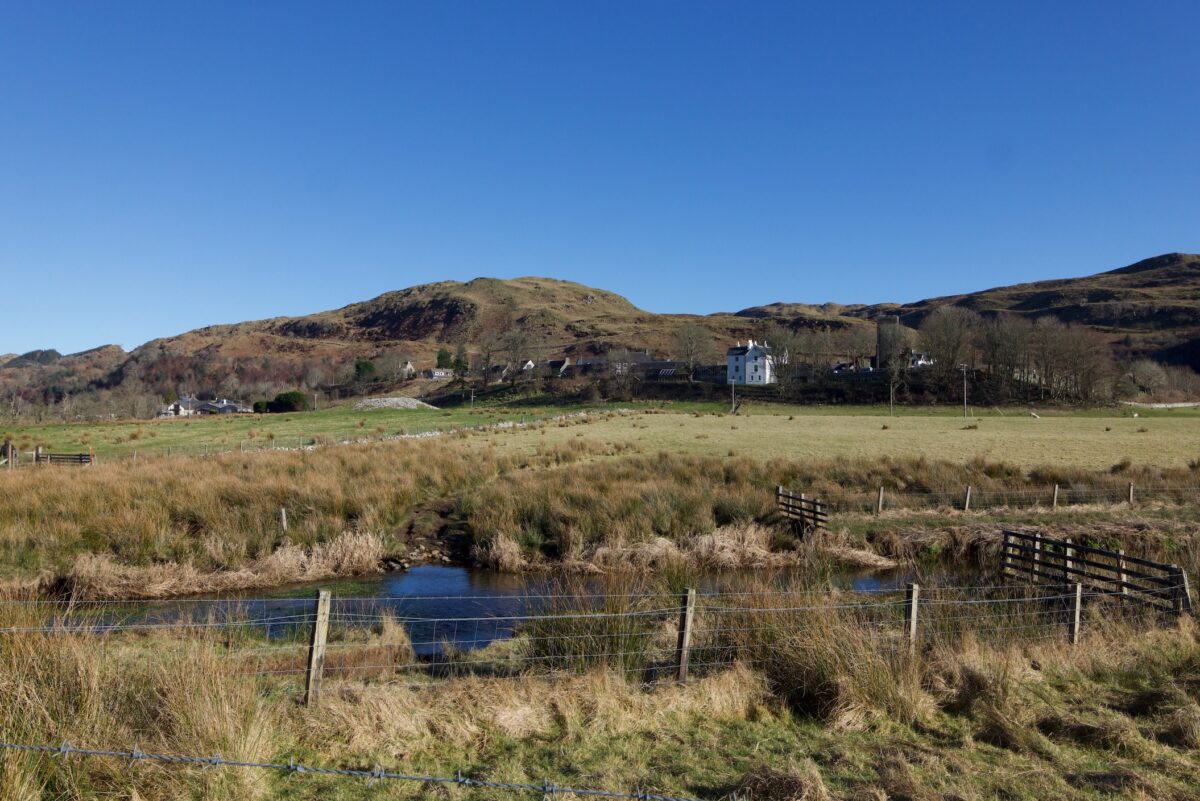
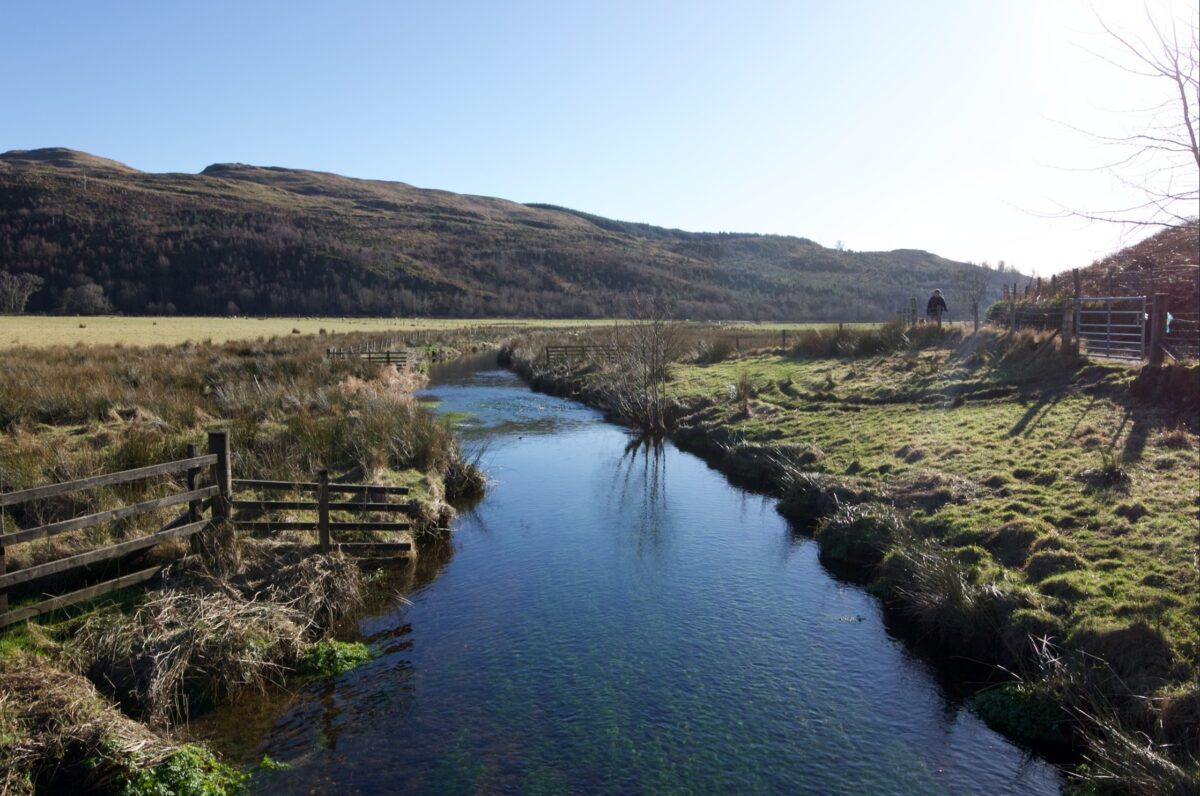
Looking back across Kilmartin Burn towards Glebe Cairn
Nether Largie North Cairn
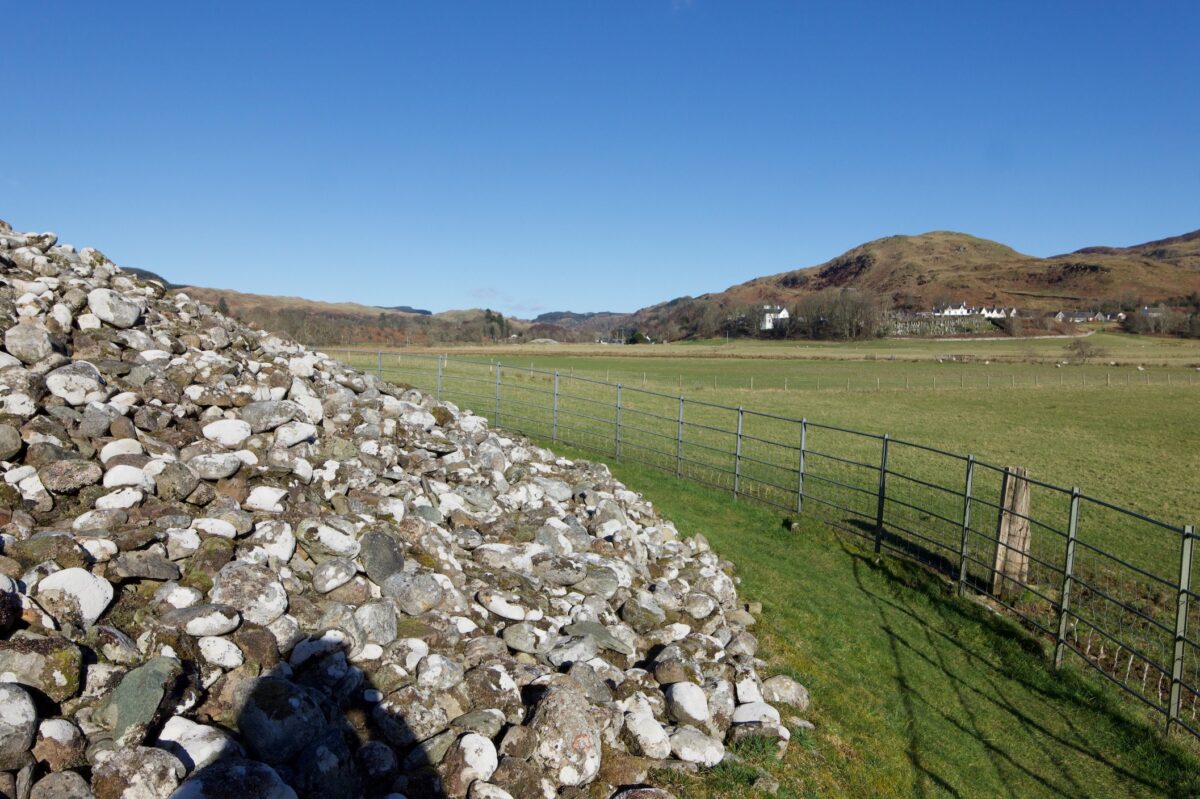
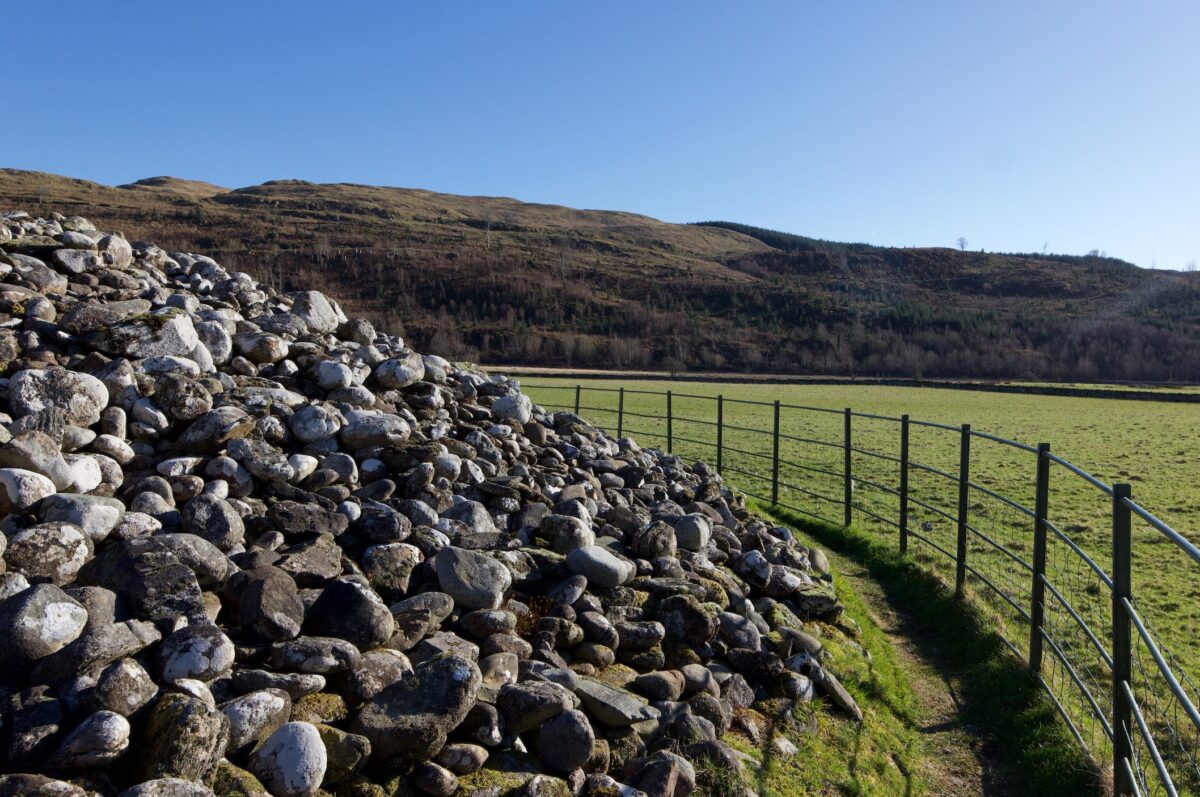
We crossed the Kilmartin Burn, which was flowing briskly, and continued down the glen, arriving at the next cairn in the linear cemetery which is Nether Largie North. Another heap of stones, you might think, and that’s an undeniable truth. However, I remembered seeing on a couple of TV programmes that it’s possible to go inside Nether Largie North via a kind of trap door that opens in the top, and I was quietly hopeful that I might get to do this. I was slightly disappointed, therefore, to find that the door was firmly sealed up. That’s understandable, I guess, because I expect it’s a difficult clamber down, and some visitors might get into difficulty.
Like Glebe Cairn, Nether Largie North dates from around 4,000 years ago. The sign here mentions the feat of engineering expertise that must have required a significant workforce to collect the stones and put them in position. It also reveals that stones have been taken from the cairn in more recent centuries to build walls, roads and drains (and the same must have happened to other cairns, too).
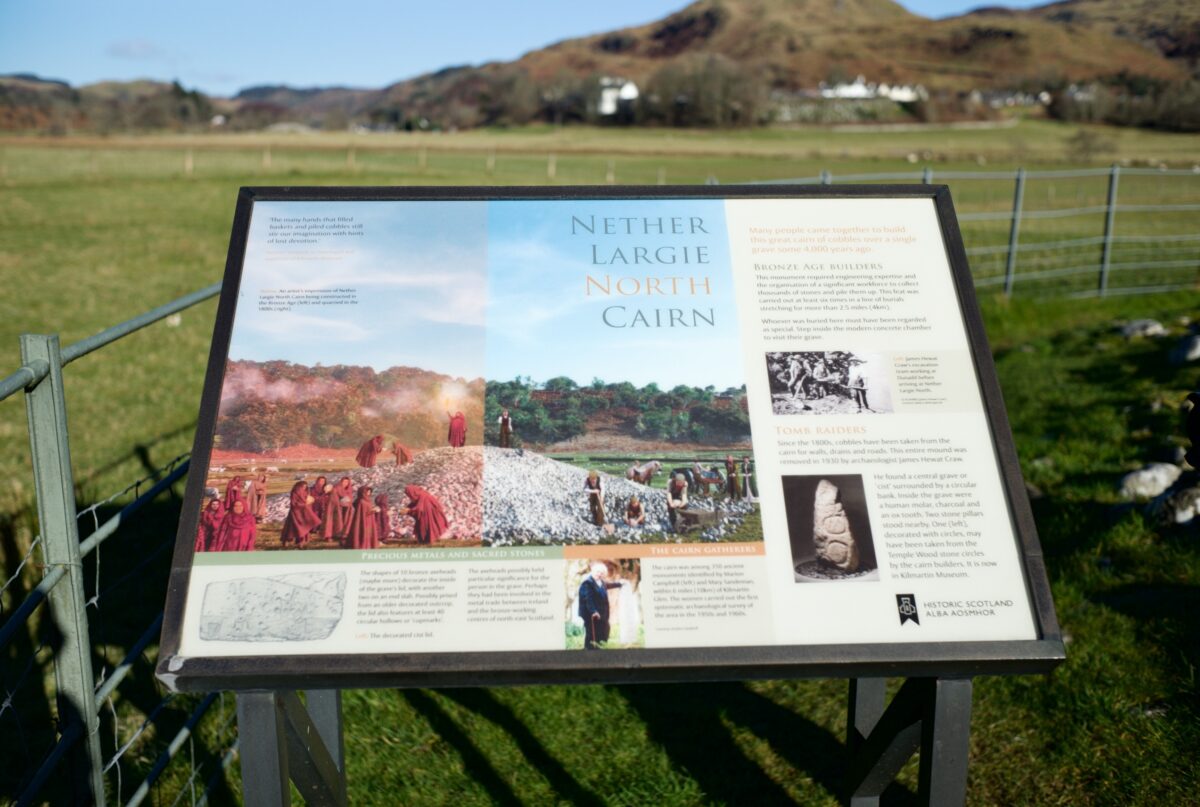
Above: Information sign showing a split image with Bronze Age builders on the left, and farm labourers (likely mid or late 1800s) collecting stones with horse and cart on the right. There was little awareness of the significance or even the age of these structures at that time.
In 1930, Nether Largie North (and its southern neighbour, which I’m coming to in a minute) were excavated by an archaeologist called James Hewat Craw. Craw’s method was to remove the entire mound of water-worn stones so that he could get a clear picture of what they covered. He found a single large cist which had been dug into the ground, topped by a slab that had been decorated on its underside with scores of cup-marks and about ten carvings that looked like axeheads.
Within the cist, Craw found only ‘only a few fragments of charcoal, a little ochre, and a human molar tooth… which fell to pieces when it was lifted.’ (Ochre is a reddish-orange pigment derived from iron oxide; it has been found in many graves of the Bronze Age and earlier, both in Britain and elsewhere. Its symbolism is still unclear.)
A short distance away from the cist, Craw found a slab of stone about five and a half feet long which may have originally covered another grave, but excavation failed to find any traces of an interment. Curiously, at the southern end of this slab, two upright stones had been set in the ground, one of which had been carved with two circles, one above the other.
In addition, about nine or ten feet from the central cist, Craw found an oval pit which yielded an ox tooth and fragments of charcoal. Kilmartin Museum’s guide says that this ‘might have been a grave, or the remains of a pit dug for a funerary feast.’
Craw recognised the significance of the axehead carvings on the cist’s lid, which were an unusual discovery (he knew that they had also been found at Rí Cruin cairn, at the southern end of the glen.) Interestingly, the Museum guide tells us that ‘the use of the axehead as a motif is later than the cup markings, so it is possible that this slab was originally a cup marked slab that was then moved and reshaped as a cist slab, and the axehead carvings added.’ The implication is that the person buried beneath such highly decorated stones was of great importance.
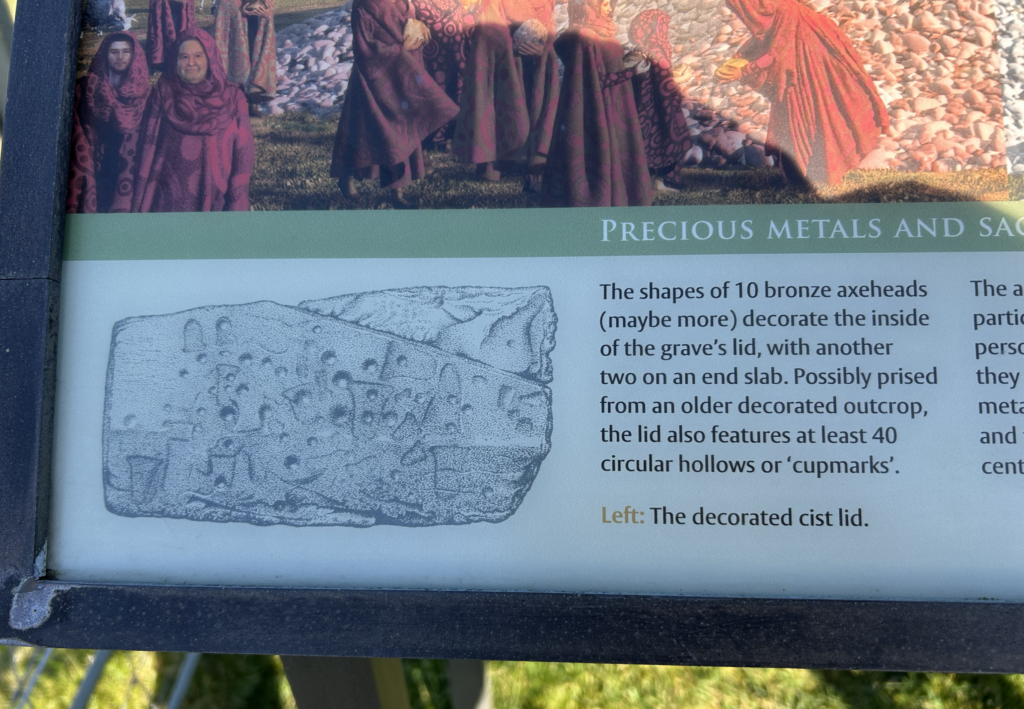
Detail from information sign showing cup-marks and axehead carvings
The cairn’s internal chamber isn’t prehistoric, but is a feature of the re-building that took place after the excavation work had finished. No access to the graves would have been possible after the original mound of stones had been raised on top of them.
Nether Largie Mid Cairn
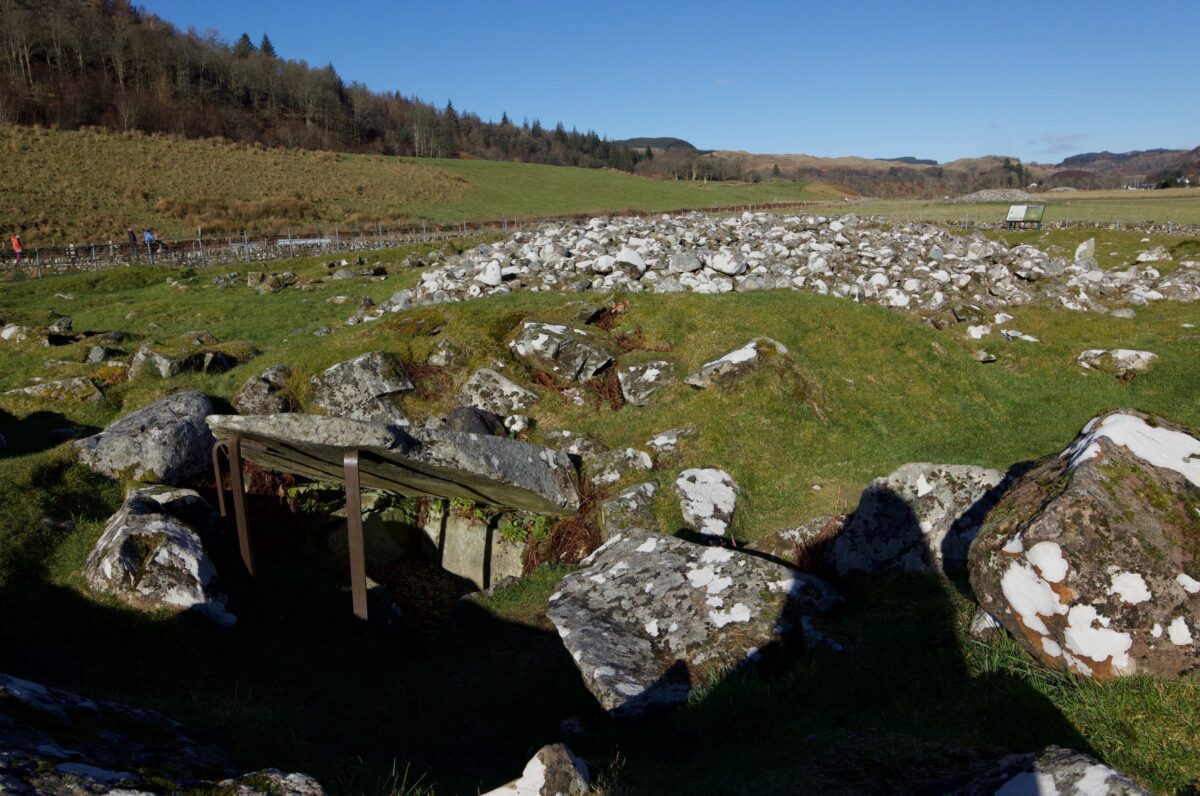
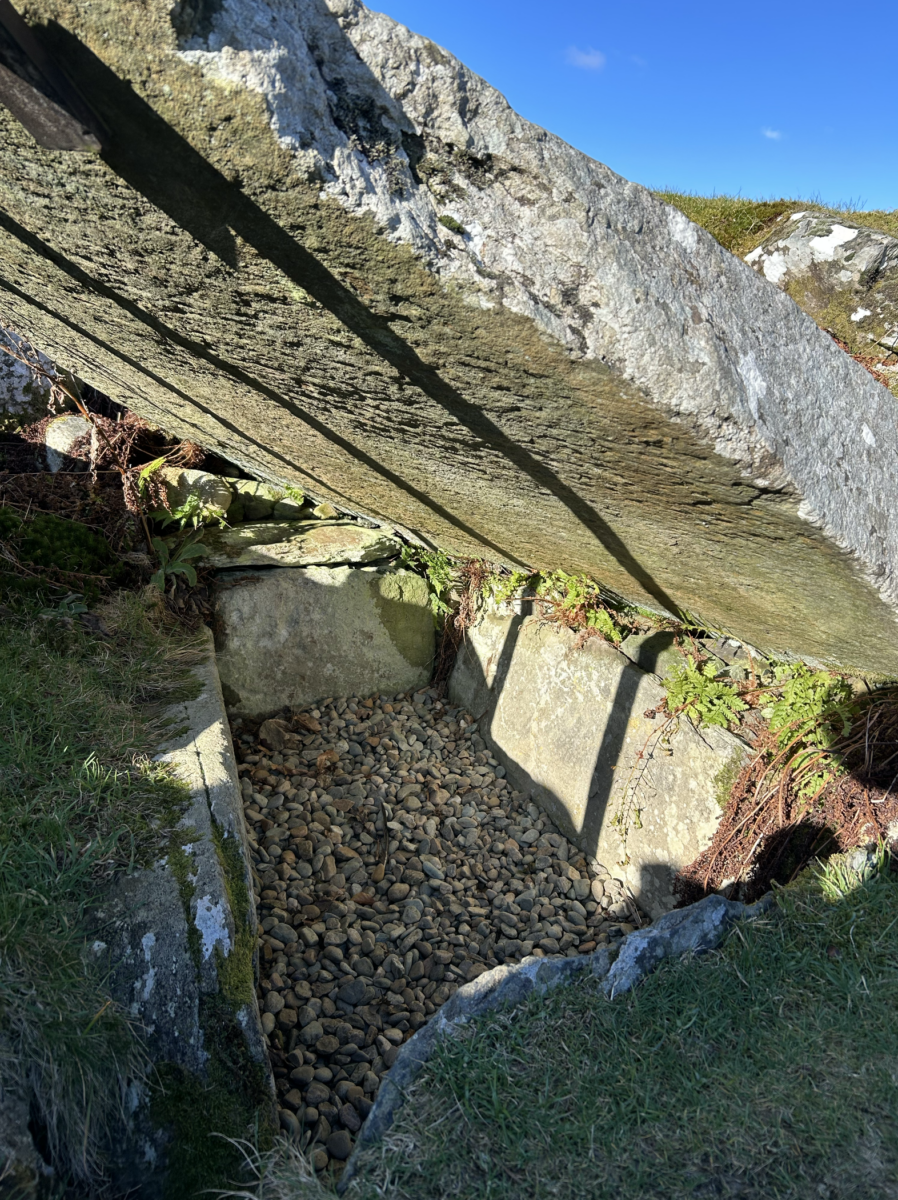
About 200 yards to the south is Nether Largie Mid Cairn, which Craw excavated in 1929. Two cists were found, but neither contained any human remains or artefacts. The surviving mound of stones seems more dispersed than the others, and Craw himself commented that ‘it was said to have been about 10 feet in height, but most of the stones had been removed not long before for repairing roads.’ One of the cists is still exposed, its covering slab propped up so that a cavity is visible. Here, the two side slabs were deliberately grooved so that the end slabs could be fitted into them, in the same way that a carpenter might make a wooden box. One of the end slabs is carved with an axehead and a cup-mark.
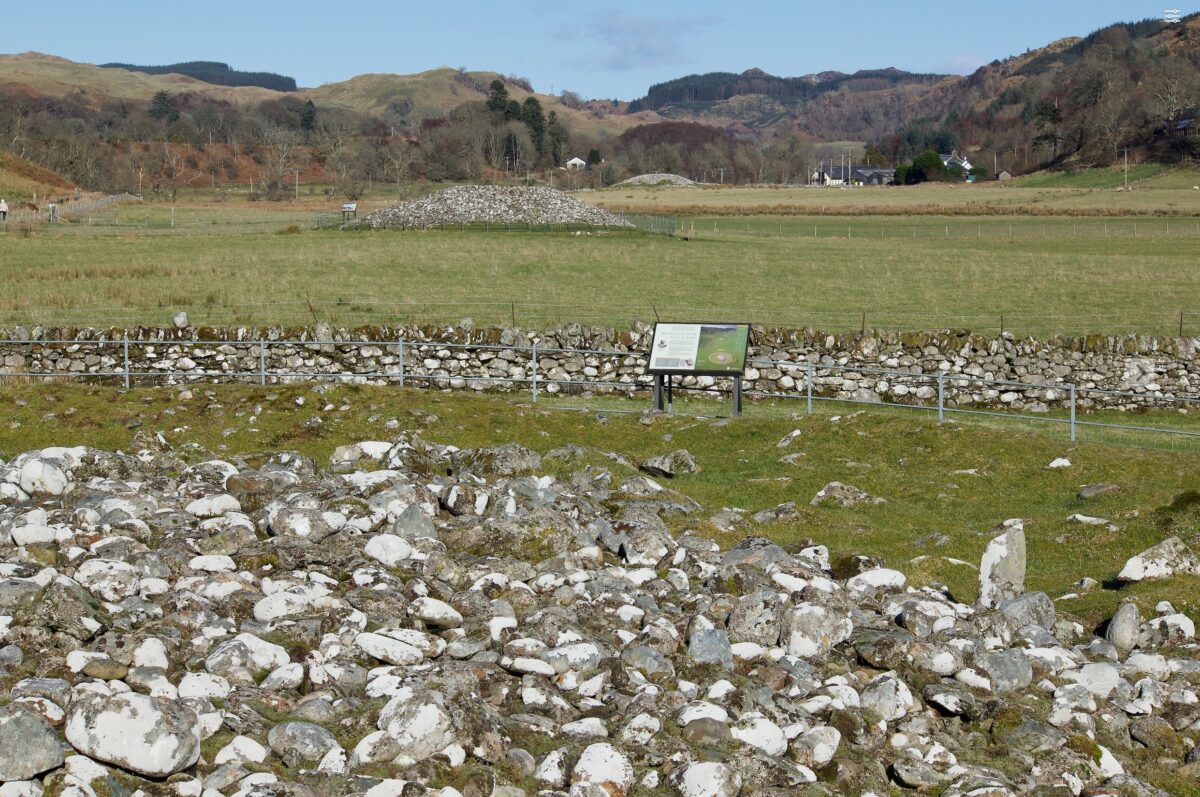
Above: View over Mid Cairn, looking north towards Nether Largie North and Glebe Cairns. Below: Detail from information sign showing the layout of the linear cemetery. The illustration shows the three cairns we’re looking at above.
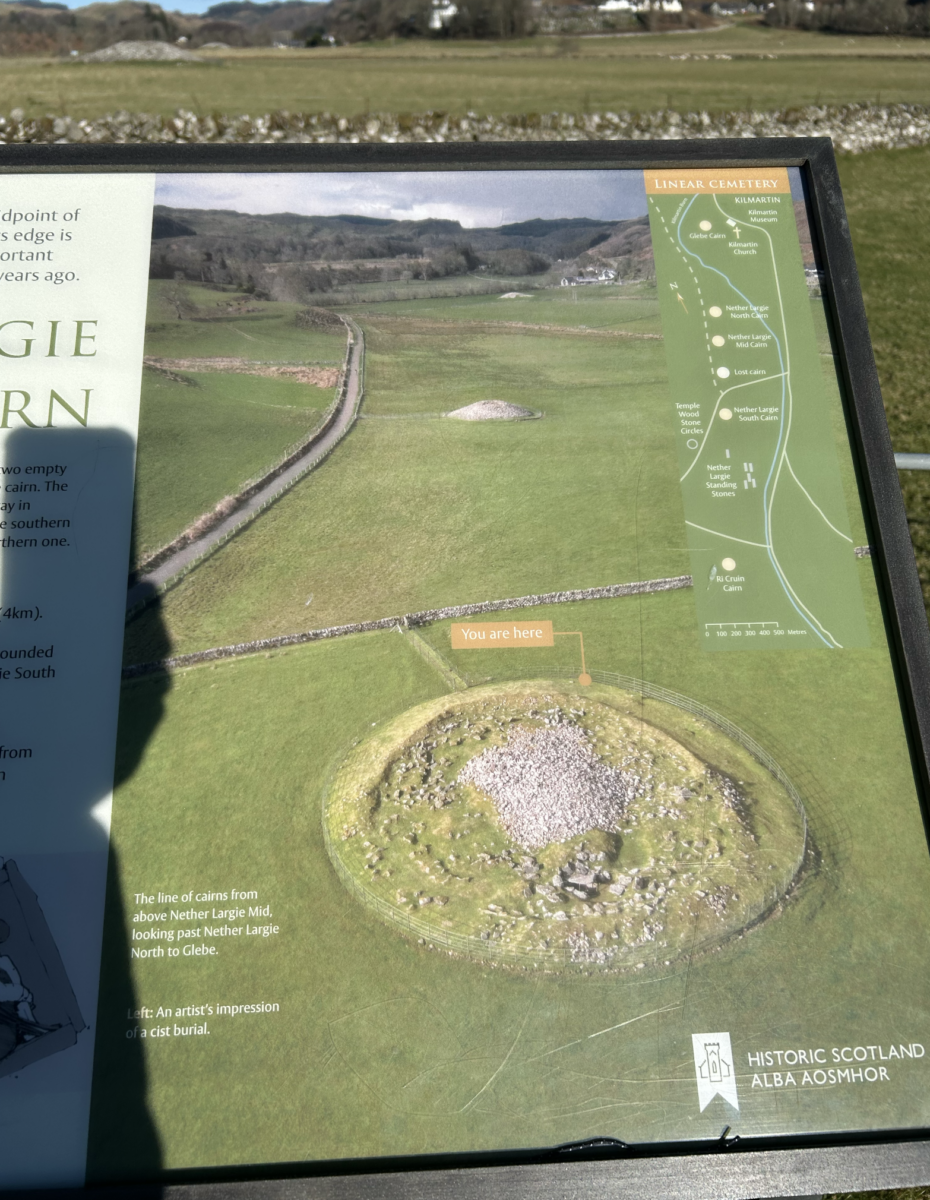
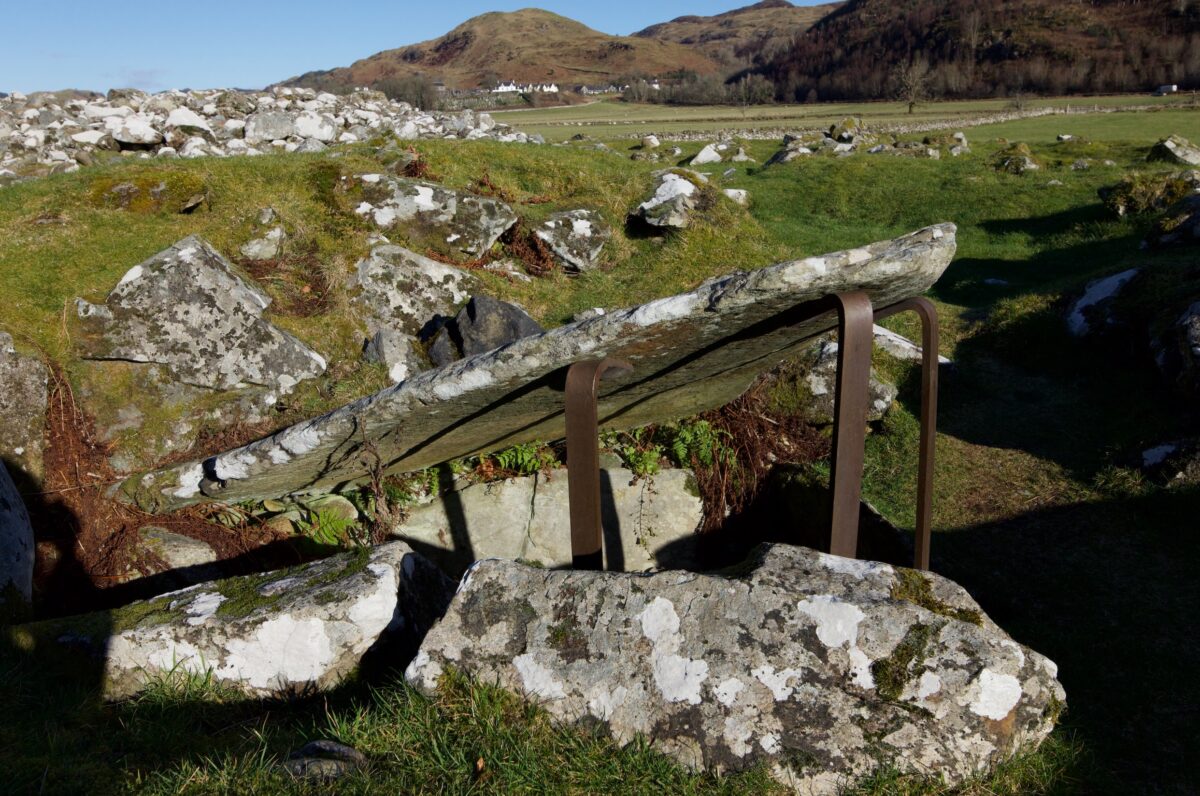
Above and below: the exposed cist at Mid Cairn
From here, the linear cemetery continues southwards, past the site of a cairn that is now lost, and on to Nether Largie South Cairn – the oldest in the line, with Neolithic origins. At the far end is Rí Cruin Cairn, which is traditionally held to be the resting place of a king. It’s thought that in the Bronze Age the linear cemetery was a burial place of the elite, who derived power from controlling the flow of metal up the Great Glen to bronze-working centres in north-east Scotland.
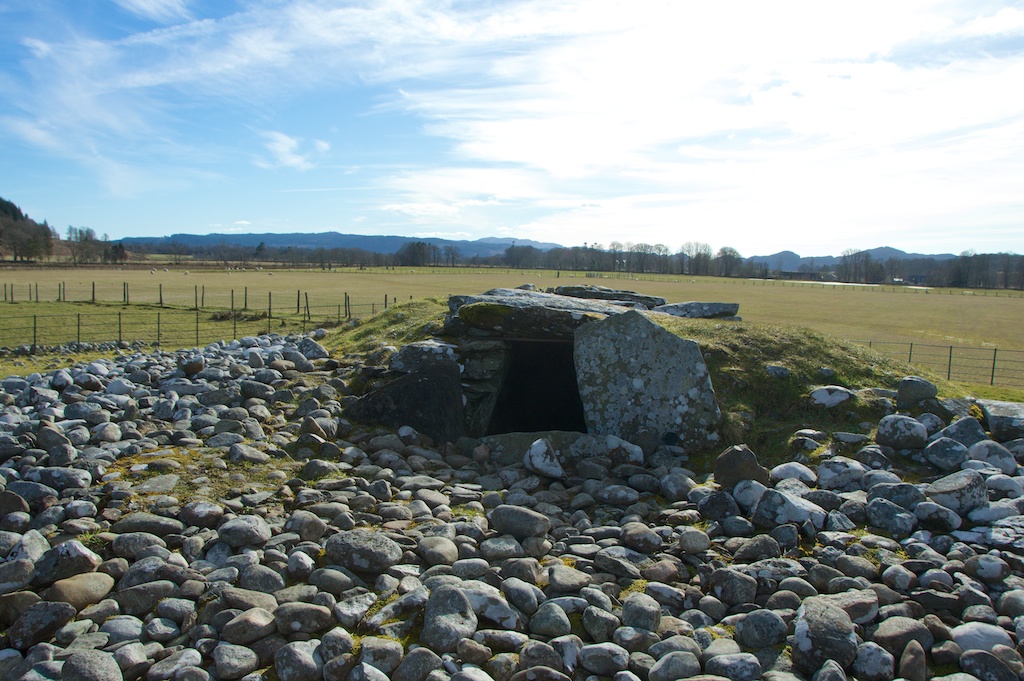
Above: Nether Largie South and (below) Rí Cruin Cairn. For full blog posts, click on the images
Even if you’re fascinated by archaeology, I’ve got to admit that one cairn on its own doesn’t present a hugely arresting spectacle. It’s a special experience to see a whole line of them, however, arranged in sequence down an undeniably beautiful glen – particularly when they’re set against a backdrop of hills and ridges whose profile can’t have changed much in thousands of years. The course of the Kilmartin Burn has been straightened in recent centuries so that it’s less likely to flood farmers’ fields, but at one time it meandered around the cairns before flowing down to the Moine Mhòr and joining the River Add on its own journey to the sea. And when the burn did burst its banks, I can imagine the mounds being reflected in its flood water. Picturing this, under a brilliant winter sky, was certainly a great way to spend an afternoon.
A few further thoughts…
In 1909, historian Patrick Hunter Gillies wrote that Kilmartin Glen was ‘studded with cairns, megaliths, inscribed stones, forts, and other monuments of antiquity’, and added that the number of these was ‘but a tithe [tenth] of what existed two centuries ago.’ According to Gillies, ‘old men who were alive at the beginning of the last century spoke of more than a score of cairns and many standing stones being removed to make room for the plough, or to build dykes and form steadings.’ That almost hurts to think about. However, we’re incredibly lucky that so many sites have survived.
Gillies noted that the old name for Kilmartin Glen was Strathmore of Ariskeodnish; he suggested that Ariskeodnish meant ‘the territory of the Scots’, referring to the kingdom of Dál Riata which flourished between the 5th and 9th centuries AD and whose main fortress was Dunadd in the south of the glen. I’m not a Gaelic scholar, but I find it interesting that there’s a place-name of Scotnish (and Caol Scotnish) down towards Tayvallich. I wonder if this preserves the old name.
The ‘unctuous matter’ that Canon Greenwell found in the cist beneath Glebe Cairn reminded me that I’d read a similar thing about Dunchraigaig Cairn, which is not far from the linear cemetery. Reginald Mapleton, another churchman and antiquary, excavated a burial at Dunchraigaig in the late 1800s, and reported that ‘the bones were of the consistence of butter, or new cheese, and seemed almost to melt between the thumb and finger.’ How devastating, to picture these relics crumbling to dust Indiana Jones-style – but I think it’s also good to remember that these early archaeologists were pioneers, and in most cases they were working out the best techniques as they went along. They didn’t have the technology or the tools that we can take advantage of. Maybe in time our own descendants will wish we’d left things undisturbed in the soil for just a few hundred years longer, and part of me is also glad to think of hidden treasures that will never be found.
Deer carving on the underside of the capstone at Dunchraigaig Cairn
–
Some of the finds from these cairns are on display in Kilmartin Museum.
Photos copyright Colin and Jo Woolf
Reference:
- Sharon Webb, In the Footsteps of Kings – a guide to walks in and around Kilmartin Glen (2012)
- William Greenwell, ‘An Account of Excavations in Cairns near Crinan’, Proceedings of the Society of Antiquaries of Scotland, November 1865
- James Hewat Craw, ‘Excavations at Dunadd and at other sites on the Poltalloch Estates, Argyll,’ Proceedings of the Society of Antiquaries of Scotland, 1930
- James Hewat Craw, ‘Further Excavations of Cairns at Poltalloch, Argyll,’ Proceedings of the Society of Antiquaries of Scotland, November 1931
- Patrick Hunter Gillies, Netherlorn, Argyllshire and its Neighbourhood (1909)
Other blog posts about sites in or near Kilmartin Glen:


16 Comments
bobhay87266bdc55
Great to see another report Jo and a lot to digest. As a matter of interest red ochre was traded thousands of miles across Australia by the Aborigines. It had magical properties to them like human blood.
Jo Woolf
Thank you for that, Bob. Interesting to know that the Aboriginal people revered it too. Both ochre and blood contain iron… on a scientific level you can see how it must have come about but I’d love to know what magical properties it was reputed to have.
Bob Hay
Wilgie Mia, also called Thuwarri Thaa (‘red ochre hole’)[1] is an ochre mine in the Weld Range of Western Australia. It has been in use for 27,000-40,000 years, during which an estimated 14,000 cubic metres (490,000 cu ft) of ochre and rock was mined.[2] This has led to suggestions that Wilgie Mia is the world’s oldest continuing mining operation.[2]
The Mine
Wilgie Mia is the largest and deepest historic Aboriginal ochre mine in Australia.[1] It is located in a hillside of the Weld Range, near the northwest town of Cue. Worked to a depth of 20 metres, scaffolds had lined the seam face beyond an opening 30 metres across. Archaeological excavations have recovered tools and equipment used in the exploitation of the resource.
Wilgie Mia and its surrounding area are of major and ongoing cultural significance and sacredness to the Wajarri Yamatji people and their neighbours. The local creation story tells that the red ochre at Wilgie Mia was formed by the blood of a red kangaroo who died there.[3]
Jo Woolf
How amazing! Thank you for that, Bob. By those dates, the use of ochre in the Bronze Age must have already seemed ancient to the cairn builders in Kilmartin.
David Williams
Several years ago, I wrote a small book about cairns, Cairns: Messengers in Stone, which wove the human and natural history of cairns from around the world. One of the highlight was researching ancient cairns, such as the ones you describe. We were supposed to come to Scotland to see them but unfortunately had to cancel the trip due to a volcanic eruption in Iceland. Someday I hope to see them. Loved reading about your experiences.
Jo Woolf
Thank you, David. I’m sorry to hear you had to cancel your visit – were flights cancelled because of the ash, or did you divert to Iceland to see the volcano instead? There’s certainly a good concentration of cairns in Argyll and in Scotland as a whole. I hope you can make it over here to take a look at them.
James Rule
THanks, again, Jo. You prompt me to work on my burial instructions….
Jo Woolf
That wasn’t really my intention, James! But it’s true that a lot of forethought must have gone into these cairns.
Bob Hay.
Always amazes me Jo reflecting on the plethora of cairns and standing stones we have in Scotland but not one dolmen, though common in the rest of the Atlantic Neolithic Cultures.
Interestingly enough prolific in the Far East.
Jo Woolf
That’s an interesting point. Why no dolmens in Scotland? That’s going to puzzle me now!
davidoakesimages
No doubt another good read… so book marking for later 🙂
Jo Woolf
Thank you David, I hope you enjoy it!
Finola Finlay
Lovely report, Jo. P Just the name Nether Largie conjured up all kinds of wonderful images. In Ireland, we would be absolutely salivating to find images of ax heads mingled with cup marks. Let alone deer!
Jo Woolf
Thank you, Finola. I know, what a lovely name is Nether Largie! And with those carvings, you can’t help but wonder how many are still under the ground, or even somewhere in plain sight.
Richard Miles
Hi Jo,
I have always been amazed and impressed by the physical effort and motivation required to build those stone monuments by these ancient peoples.Pure physical effort over a prolonged duration.
Is the archaeologist Augustus Pitt Rivers that you mention the same one who created and developed the Pitt Rivers museum in Oxford ? Really worth a visit,basically one large room crammed full of artifacts from around the world.
Jo Woolf
Hi Richard, yes, it’s difficult to imagine the amount of effort that must have been involved, and the number of people required to build these places. There are still so many unanswered questions! That is the same Pitt Rivers, and I’d love to visit that Museum – I’ve read about it and from what you say it sounds like it contains some real treasures.